

.webp)
Fiddle Leaf Fig Problems
Ficus lyrata
Ficus lyrata is prized for its large, violin-shaped leaves but is notoriously demanding. It drops leaves when moved, brown-spots from root rot or bacteria, and requires consistent bright indirect light.
All Fiddle Leaf Fig Problems
 ⚠ Critical
Fiddle Leaf Fig Brown Spots from Root Rot — Dark Blotches Spreading from Leaf Base
Large, irregular dark-brown to rust-coloured spots appear on the lower leaves first, typically spreading from the base or edges of the leaf inward. The spots have a water-soaked appearance initially before turning dry and papery. Multiple leaves on the lower portion of the plant are affected simultaneously. This is the most common and most destructive Ficus lyrata problem: root rot from overwatering. The spots appear on leaves because the damaged root system can no longer supply adequate water and nutrients, and Phytophthora-produced toxins travel upward in the vascular system.
 ⚠ Moderate
Fiddle Leaf Fig Sudden Leaf Drop — Environmental Shock & Relocation Stress
Multiple leaves drop simultaneously or in rapid succession within days of the plant being moved, repotted, or after a significant environmental change. Remaining leaves may be otherwise healthy. Ficus lyrata is extraordinarily sensitive to change — it is one of the most location-sensitive of all houseplants. Moving it even a few metres to a different light exposure, or a change in temperature, humidity, draught, or watering regime, can trigger a dramatic stress response of mass defoliation. This is not a sign the plant is dying — it is a measurable physiological response to perceived instability.
 ⚠ Moderate
Fiddle Leaf Fig Brown Leaf Edges — Low Humidity & Inconsistent Watering
The edges of large leaves turn dry and crispy brown, progressing inward from the margin. The brown zone is sharply delineated from healthy green tissue. Unlike root-rot spots (which are irregular, blotchy, and spreading), edge browning follows the leaf margin consistently. This pattern indicates transpiration-related stress — the leaf margins are the furthest point from the central vascular supply and are the first to suffer when humidity is low, the soil fluctuates between very dry and very wet, or salts accumulate at the roots.
 ⚠ Minor
Fiddle Leaf Fig Not Producing New Leaves — Light Deficiency & Seasonal Dormancy
The plant produces no new growth for weeks or months. The growing tip remains static with no visible bud swelling or emergence. Existing leaves are healthy and the plant otherwise looks stable. Ficus lyrata requires substantial bright indirect light to produce new growth — it is a forest-edge tree that receives bright, filtered light for most of the day in its native habitat. Indoors, positions more than 2 metres from a bright window often provide insufficient light energy to fuel leaf production, even though the plant survives indefinitely in these conditions.
 ⚠ Critical
Fiddle Leaf Fig Bacterial Infection — Spreading Brown Spots with Yellow Halos
Small, water-soaked brown spots appear across the leaf surface, each surrounded by a distinct yellow halo. Unlike root-rot spots (which typically start at leaf margins or bases), bacterial spots appear anywhere on the leaf and spread rapidly in humid, warm conditions with poor air circulation. The spots merge to form larger irregular patches. Bacterial leaf spot in Ficus lyrata is caused primarily by Pseudomonas cichorii and enters through wounds or natural leaf openings, spreading via water droplets from watering or misting.
 ⚠ Critical
Fiddle Leaf Fig Root Rot — Overwatering in Dense Substrate
The plant droops and wilts despite moist substrate, lower leaves yellow and fall, and a musty smell rises from the pot when watered. The substrate remains wet for more than 10-14 days after watering. Fiddle Leaf Figs have a naturally shallow, spreading root system adapted to the well-drained forest floor of their native West Africa. In dense potting mix without adequate drainage, roots sit in waterlogged conditions and are rapidly colonised by Pythium and Phytophthora water moulds that destroy root tissue.
 ⚠ Minor
Fiddle Leaf Fig Sunburn — Bleached Patches from Direct Sun Exposure
Large, pale tan or white patches appear on leaves that were previously healthy, in areas exposed to direct sunlight. The patches are dry and papery, with sharply defined edges corresponding to the shadow line of the window frame or a change in light angle. Surrounding leaf tissue remains green and healthy. Ficus lyrata is acclimatised to bright filtered light — direct sun, particularly through glass which magnifies UV intensity, rapidly destroys chlorophyll in cells that have not developed protective pigmentation.
 ⚠ Moderate
Fiddle Leaf Fig Scale Insects — Brown Bumps on Stems & Leaf Undersides
Small, round or oval brown bumps (2-4 mm) appear along stems, at branch junctions, and on the underside of leaves near the midrib. The bumps are hard-shelled and do not move when touched. Leaves become sticky with honeydew and develop black sooty mould. The plant gradually declines with yellowing leaves and reduced vigour. Scale insects (Coccidae and Diaspididae families) are among the most difficult houseplant pests to treat because their waxy or armoured shells protect them from contact insecticides.
 ⚠ Moderate
Fiddle Leaf Fig Transplant Shock — Leaf Drop After Repotting
Immediately or within 1-3 weeks of repotting, the plant drops multiple leaves, wilts, and shows no new growth. Remaining leaves may yellow slightly. This is the most stressful event in a Ficus lyrata's life apart from moving — root disturbance during repotting disrupts the plant's carefully established water uptake system, triggering a stress response. The scale of leaf drop typically correlates with the extent of root disturbance during the repot.
 ⚠ Moderate
Fiddle Leaf Fig Yellow Leaves — Overwatering, Nutrient Deficiency & Stress
One or more leaves turn solid yellow, beginning at the older lower leaves (overwatering/nutrient depletion) or affecting newer growth (acute stress or nutrient lockout). Unlike brown spots from root rot, yellowing is a whole-leaf colour change rather than localised lesions. Yellow leaves on Ficus lyrata almost always indicate a care issue that has been ongoing for weeks — the plant has significant leaf reserves and typically does not yellow quickly in response to short-term problems.
 ⚠ Moderate
Fiddle Leaf Fig Spider Mites — Pale Stippling and Webbing on Large Leaves
The large, textured leaves of Ficus lyrata develop a pale, bronzy stippled surface as spider mites pierce individual cells and extract their contents. Fine webbing becomes visible between leaf surfaces and stems when infestations are advanced. Because Ficus lyrata leaves are large and somewhat rough-textured, mite webbing can be missed in early stages — inspect the leaf undersides carefully. Spider mites in Ficus lyrata typically arrive from neighbouring plants or through open windows and establish quickly in warm, dry indoor conditions.
 ⚠ Moderate
Fiddle Leaf Fig Mealybugs — White Cottony Colonies at Stem Nodes
White cottony or waxy masses appear at stem nodes, in leaf axils, and along the midrib on the underside of leaves. Leaves become sticky with honeydew. Ficus lyrata is particularly susceptible to mealybug colonisation at the growing tip — infestations here distort new leaf emergence and can permanently damage the apical growing point if untreated. Mealybugs are protected by their waxy coating and reproduce rapidly in warm indoor conditions.
 ⚠ Minor
Fiddle Leaf Fig Dry Brown Leaf Tips — Fluoride & Salt Accumulation
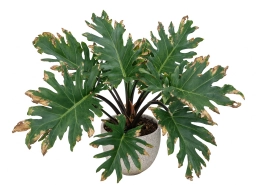
The tips of large Ficus lyrata leaves turn papery brown and dry, progressing inward along the leaf margins in a clean, defined line. The rest of the leaf remains healthy green and firm. This tip necrosis follows the classic pattern of fluoride toxicity or fertiliser salt accumulation — minerals concentrate at the leaf tips as water evaporates through the stomata, reaching toxic concentrations that kill the cells at these extremities.
 ⚠ Minor
Fiddle Leaf Fig Leggy Bare Trunk — Leaf Loss and Sparse Growth from Low Light
The lower portion of the trunk becomes bare as older leaves drop, while the plant continues to produce a sparse cluster of leaves only at the very top. New leaves are smaller than expected for the cultivar. The overall appearance is a tall, thin trunk with minimal foliage — the characteristic 'palm tree' look that indicates chronic low-light stress. Without sufficient light, Ficus lyrata cannot maintain its lower canopy of large leaves and progressively sheds them to concentrate its limited energy on the apical growing point.
 ⚠ Moderate
Fiddle Leaf Fig Thrips — Silvery Scarring and Distorted New Leaves
The large leaves develop a silvery, shiny, scratched appearance as thrips rasp the surface cells. New leaves emerge from the growing tip already scarred, curled, or with brown streaks embedded in the tissue. Ficus lyrata is particularly vulnerable to thrips damage at the growing tip because the new leaves take weeks to unfurl, and thrips feeding during this period creates permanent deformities that persist for the life of the leaf. Black frass specks appear on leaf undersides.
Fiddle Leaf Fig Care Guide
Light, watering, humidity, fertilising, repotting and propagation — everything you need to keep your Fiddle Leaf Fig thriving.
Full care guide →See how growers fixed these problems
Browse real Fiddle Leaf Fig grow diaries from the community — treatments, timelines, and results.
Browse community diaries →Common Fiddle Leaf Fig Questions
Why does my Fiddle Leaf Fig have brown spots?
Large, irregular dark-brown to rust-coloured spots appear on the lower leaves first, typically spreading from the base or edges of the leaf inward. The spots have a water-soaked ap… Read the full guide →
Why is my Fiddle Leaf Fig dropping leaves?
Multiple leaves drop simultaneously or in rapid succession within days of the plant being moved, repotted, or after a significant environmental change. Remaining leaves may be othe… Read the full guide →
How do I treat Fiddle Leaf Fig root rot?
The edges of large leaves turn dry and crispy brown, progressing inward from the margin. The brown zone is sharply delineated from healthy green tissue. Unlike root-rot spots (whic… Read the full guide →
Why are my Fiddle Leaf Fig leaf edges turning brown?
The plant produces no new growth for weeks or months. The growing tip remains static with no visible bud swelling or emergence. Existing leaves are healthy and the plant otherwise … Read the full guide →