


Plant Comparison
Calathea vs Alocasia
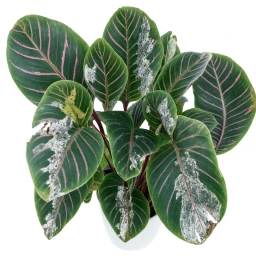
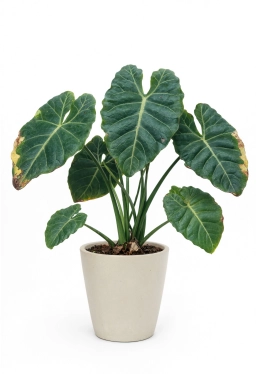
The quick way to tell them apart: Calathea leaves look painted (stripes, feathers or rings, often purple underneath) and fold upward at night, and the plant grows in a low clump. Alocasia leaves are arrow- or shield-shaped on long stems, with thick, contrasting veins, and the plant grows from an underground corm that can go dormant. Calathea and Alocasia are two of the most visually striking tropical houseplants — but both are also notoriously demanding. Calathea is famous for its patterned, prayer-like leaves; Alocasia for its huge, arrow-shaped foliage. Both require high humidity and careful watering, but they differ significantly in what they punish you for getting wrong.
Calathea
Calathea spp.
Calathea is prized for its striking patterned foliage and nighttime leaf movement. It is demanding — sensitive to tap water, low humidity, cold draughts, and inconsistent watering.
Alocasia
Alocasia spp.
Alocasia — the Elephant Ear — produces dramatic arrow-shaped leaves but goes dormant in winter. It is susceptible to root rot, spider mites, low humidity, and crown rot.
Side-by-Side Comparison
Choose Calathea if…
- ✓You want patterned, decorative foliage with daily leaf movement
- ✓You have medium indirect light without a very bright windowsill
- ✓You're happy to use filtered or rainwater for watering
- ✓You want a plant that stays evergreen year-round without dormancy
Choose Alocasia if…
- ✓You want the biggest, most architectural leaves possible
- ✓You have a bright spot and can maintain high humidity
- ✓You don't mind the plant going dormant in winter
- ✓You want fast, dramatic growth during the growing season
What They Have in Common
- •Both require high humidity (60%+) and suffer in dry heated rooms
- •Both are sensitive to cold draughts and temperature swings
- •Both are non-toxic to cats and dogs
- •Both are classified as advanced houseplants requiring consistent care
The Verdict
Neither Calathea nor Alocasia is easy — but Alocasia is more forgiving about water quality, and its dormancy in winter is a feature rather than a bug (it's resting, not dying). Calathea's tip-burn from tap water and constant high humidity needs make it the more demanding of the two.
🍃 Calathea
🐘 Alocasia
Real Alocasia grow diaries
Growers on DailyGrowers log their plant week by week, one photo at a time. Here's how theirs are going.
 2 weeks
alocasia dragon scale
@yoyo
 1 week
Конь Регал
@nataligroy
 1 week
Alocasia Frydek
@alocasias4life
 1 week
Alocasia Sarian Albo
@alocasias4life
 1 week
Моя будущая дракониха
@nataligroy
 1 week
Блэк
@nataligroy
Growing Alocasia too? Start your own diary. It's free and takes 2 minutes.
Start my Alocasia diary →