


Alocasia Care Guide
Alocasia spp.
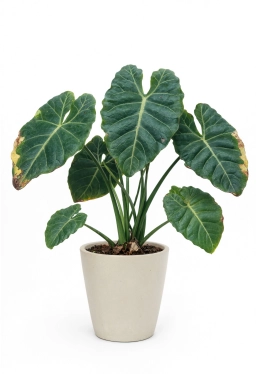
Alocasias (elephant ears) are dramatic statement plants with large, arrow-shaped or shield-shaped leaves. They are moderately demanding — requiring bright indirect light, high humidity, and careful watering. Alocasias go dormant in winter, dropping most of their leaves, which alarms new owners. This is normal behaviour; new growth resumes in spring.
Striking but demanding — needs high humidity and careful watering. Goes dormant in winter.
Care Requirements
💡 Light
Bright indirectAlocasia needs bright indirect light to maintain large leaf size. Too little light causes small leaves and leggy growth. Avoid direct sun — large leaves scorch rapidly. East- or west-facing windows are ideal.
💧 Watering
Every 7–10 daysAllow the top 3–5 cm of substrate to dry between waterings. Alocasia is susceptible to root rot — never allow it to sit in standing water. During winter dormancy, water sparingly (every 2–3 weeks) until growth resumes.
💦 Humidity
60–80%High humidity is important — brown leaf edges indicate humidity is too low. A humidifier positioned nearby is the most reliable solution. Avoid misting, which can promote fungal leaf spots.
🌡️ Temperature
18–30°CAlocasia dislikes cold — keep above 15°C. Cold draughts trigger premature leaf drop and early dormancy. Consistent warmth (20–25°C) promotes the most vigorous growth.
🌱 Substrate
Chunky, well-drainingUse a mix of potting soil, perlite (30%), and orchid bark. Alocasia roots need high oxygen levels. Dense substrate causes root rot. Terracotta pots support better drainage than plastic.
⚗️ Fertiliser
Every 2–4 weeks (spring–summer)Feed with a balanced liquid fertiliser every 2–4 weeks during the growing season. Alocasia is a heavy feeder when actively growing. Stop fertilising entirely from October to February.
Seasonal Care
Alocasia goes dormant in winter — it may drop all its leaves and appear dead. This is normal. Keep the corm warm, water minimally (once every 3 weeks), and new shoots will emerge in spring. Do not overwater a dormant plant — this kills the corm. New leaf production resumes when day length increases in late February or March.
Repotting
Repot in spring when roots are visible at drainage holes. Alocasia produces corms (baby plants) around the base — these can be separated and potted individually to propagate. Repot into a pot only slightly larger than the current one.
Propagation
The easiest method is separating corms (offsets) at repotting. Each corm will produce its own plant when potted in moist substrate and kept warm (22°C+). Division of the main rhizome is also possible but carries higher risk.
Alocasia FAQs
Why is my Alocasia losing all its leaves?
Leaf drop in Alocasia is most commonly winter dormancy — a normal, natural process as day length shortens. Keep the corm warm, water minimally, and new growth will emerge in late winter or spring. If leaf loss occurs in spring or summer, check for root rot or extreme drought stress.
Why are my Alocasia leaves drooping?
Drooping usually indicates underwatering or root rot. Check the substrate — if dry, water immediately. If wet, allow to dry and check the roots for rot. Alocasia also droops in cold conditions or after being moved.
How much light does Alocasia need?
Bright indirect light is ideal — near a window but not in direct sunlight. Insufficient light results in small leaves and slow growth. Alocasia will not thrive in low-light conditions like a corner or hallway.
Something wrong with your Alocasia?
Browse our full diagnosis guide — identification, treatment, and prevention for every common Alocasia problem.
Alocasia Problem Guide →Common Alocasia Pests
Spider Mite
Microscopic arachnids that cause bronze stippling and fine webbing, thriving in hot, dry indoor conditions.
View guide →
Mealybug
White waxy-coated soft scale insects forming cottony colonies at leaf axils, stems, and roots.
View guide →
Scale Insect
Armoured or soft-shelled insects that attach to stems and leaves, extracting sap under protective waxy covers.
View guide →
Vine Weevil
Nocturnal beetles whose C-shaped larvae destroy roots entirely, causing sudden plant collapse.
View guide →
Compare Alocasia
More Care Guides
.webp)
.webp)
Real Alocasia grow diaries
Growers on DailyGrowers log their plant week by week, one photo at a time. Here's how theirs are going.
 2 weeks
alocasia dragon scale
@yoyo
 1 week
Конь Регал
@nataligroy
 1 week
Alocasia Frydek
@alocasias4life
 1 week
Alocasia Sarian Albo
@alocasias4life
 1 week
Моя будущая дракониха
@nataligroy
 1 week
Блэк
@nataligroy
Growing Alocasia too? Start your own diary. It's free and takes 2 minutes.
Start my Alocasia diary →🌿
Have a Alocasia? Track its progress.
Weekly diary entries, photos, measurements — and a community of growers to learn from.