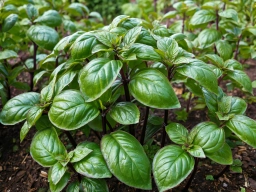
 ⚠ Minor
Minimal new leaf production despite healthy appearance � usually a light or temperature issue rather than disease.
Slow or Stalled Growth in Basil
Commonly affects: Ocimum basilicum (Basil)
The plant produces very few new leaves over an extended period and generally looks stalled rather than actively growing, despite otherwise appearing healthy and green.
The short answer
A herb that stalls — no new leaves, nothing dying — is nearly always short of light or root space, not of fertiliser. Basil needs six hours of direct sun to grow properly, and supermarket pots contain a dozen seedlings competing in a plug of compost. Move it to the brightest spot you have, and if it is a shop-bought pot, divide it. Both changes show results within two weeks.
Confirm it before you treat it
- 1Count the stems. A supermarket herb pot typically holds 10–20 seedlings crammed together; none of them can grow properly and dividing is the whole fix.
- 2Measure the light honestly. Basil wants six hours of direct sun. A bright-feeling kitchen usually provides one or two.
- 3Slide the plant out. Roots circling the outside in a solid mass mean it is root-bound and cannot take up what it needs.
- 4Check the temperature. Basil essentially stops below about 15 °C, so a cold windowsill in spring stalls it however good the light is.
- 5Look for flower buds. Once basil flowers it stops producing leaves — pinching the tips out redirects it back into foliage.
Potential Causes
- 1Insufficient light, since basil needs strong light to fuel its naturally fast growth rate
- 2Cool temperatures below 15�18�C slowing metabolic activity
- 3Nutrient-depleted soil that hasn't been fed recently
- 4Root-bound conditions in a pot that's become too small
Solution Steps
- 1Move the plant to the brightest available spot, ideally with 6+ hours of direct or strong light daily.
- 2Ensure the growing area stays consistently above 18�C, since basil is a warm-season plant that stalls in cool conditions.
- 3Feed with a balanced liquid fertiliser if the plant hasn't been fed in the past 3�4 weeks.
- 4Check the root ball for pot-bound roots and repot into a larger container if needed.
What else looks like this
| Could be | How to tell it apart |
|---|---|
| Nitrogen deficiency | Stalled growth WITH yellowing from the bottom. Light-starved basil stays green while simply doing nothing. |
| Root rot | Stalling plus wilting and wet soil. Slow growth from low light is not accompanied by wilting. |
| Natural dormancy | Applies to perennial herbs in winter, not to basil, which is an annual and either grows or is failing. |
| Transplant shock | A pause of one to two weeks after repotting or dividing, which then resolves on its own. Light-related stalling continues indefinitely. |
| Aphid damage | Distorted or sticky new growth with insects on the tips. Always check the growing point before assuming a cultural cause. |
Recovery timeline
- Day 1Move to the brightest available position and divide a crowded shop-bought pot into three or four clumps, each in its own pot.
- Days 2–7Divided plants sulk for a few days. This is normal and not a sign the division failed.
- Weeks 1–2New leaves appear at the growing tips. This is the first real evidence the light or the space was the limiting factor.
- Weeks 3–4Growth accelerates noticeably. Start pinching the tips above a leaf pair to force branching rather than height.
- OngoingHarvest regularly from the top. Basil branches in response to being cut and stalls if left alone.
If you do nothing
A stalled herb does not usually die dramatically — it just stops being useful. Leaves stay small, stems get thin and leggy as the plant reaches for light, and it eventually flowers and sets seed, at which point leaf production ends entirely and flavour turns bitter. A crowded supermarket pot left undivided typically collapses within a month or two as the seedlings exhaust the compost and shade each other out.
Common mistakes
- Adding fertiliser to a plant short of light. Nutrients cannot substitute for photosynthesis, and feeding a light-starved plant just produces weak growth.
- Leaving a supermarket pot undivided. It was grown for shelf appearance over a few weeks, not for living as one plant.
- Harvesting single leaves from the bottom. Cut whole stem tips above a leaf pair instead — that is what makes basil branch.
- Letting it flower. Once it starts, leaf production stops. Pinch buds out as soon as they appear.
- Growing it in a cold spot. Basil is a warm-season annual and simply will not move below about 15 °C.
Prevention Tip
Keep basil warm and bright year-round � it's one of the more light- and heat-hungry common herbs, and growth stalls quickly outside its preferred range.
Questions people actually ask
- Why does supermarket basil always die?
- It is a dozen seedlings forced in a small plug of compost for quick shelf appeal. Dividing it into separate pots within a few days of purchase changes its lifespan entirely.
- Will a grow light help?
- Considerably, and for most indoor kitchens it is the only realistic way to give basil the six hours of direct light it needs.
- Should I pinch out the tips?
- Yes, regularly, from when the plant has about six leaves. It doubles the number of growing points each time.
- Can I keep basil through the winter?
- It is an annual and declines regardless, though a bright warm spot extends it. Sowing fresh seed is more reliable than trying to overwinter a tired plant.
- Does it need a big pot?
- Not big, but its own. A 12–15 cm pot per plant is plenty, and it matters far more than pot size that it is not sharing.