 ⚠ Minor
Calathea pigment loss from excess light: accessory chromatophores bleach under prolonged high-intensity exposure, erasing the characteristic markings that define Goeppertia cultivars.
Calathea Fading Leaf Pattern — Light Bleaching & Pigment Loss
Commonly affects: Calathea ornata, Calathea makoyana, Calathea lancifolia, Goeppertia spp.
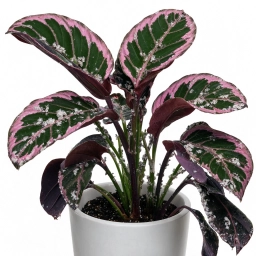
The distinctive silver, cream, or contrasting markings on Calathea leaves become muted, washed out, or uniformly pale green. New leaves emerge without the pattern definition seen in healthy specimens. The ornamental pigment cells (chromatophores) in Calathea are photosensitive — excessive light bleaches the accessory pigments that create the pattern, while insufficient light causes general chlorophyll dilution.
Potential Causes
- 1Excess direct or strong indirect sunlight bleaching the contrasting pigment cells that form the leaf pattern
- 2Light intensity above 3,000–5,000 lux causing photooxidative pigment degradation in shade-adapted leaves
- 3General nutrient deficiency (particularly nitrogen) reducing the plant's capacity to synthesise sufficient accessory pigments
- 4Age-related pattern fading on older leaves — normal progression as leaves age beyond their photosynthetically active period
Solution Steps
- 1Move the plant to bright but fully filtered indirect light — ideally 1–2 metres from an east-facing window or behind a sheer curtain in a south/west-facing room.
- 2Measure light intensity with a lux meter or smartphone app — Calathea thrives between 1,000 and 3,500 lux. Any reading above 5,000 lux risks pattern bleaching.
- 3Apply a balanced liquid fertiliser (NPK 10-10-10 or 5-5-5) at half the recommended dose every 2–3 weeks during the growing season to support pigment synthesis.
- 4If new growth continues to emerge without pattern definition under corrected light, evaluate root health — nutrient uptake issues from root damage can mimic light-induced fading.
- 5Remove heavily faded leaves to redirect the plant's energy into new, correctly patterned growth.
- 6Increase humidity to 60–70% — moisture-stressed Calatheas invest less energy in non-essential pigment production.
Prevention Tip
Never position Calathea in a spot that receives direct sun at any time of day — even morning sun through east-facing windows can bleach patterns in summer. The best test: if you can comfortably read a book there without artificial light but the sun never directly touches the pot, the light level is close to ideal.
Related Issues to Explore

Sun Scorch & Leaf Bleaching — Photooxidative Damage
Direct sun exposure causes both pattern fading and sharp-edged scorch patches — move the plant and apply a sheer curtain filter immediately.
Read guide
Nitrogen Deficiency — Pale, Uniform Yellowing
Nitrogen deficiency dilutes chlorophyll across all leaves and reduces pigment synthesis — a key differential when fading is not linked to excess light.
Read guide
Calathea Leaf Curling — Underwatering, Low Humidity or Heat Stress
Moisture-stressed Calatheas divert resources away from pigment production — resolving curl and fading often requires the same humidity and watering corrections.
Read guide