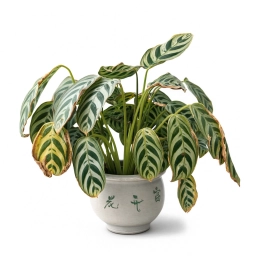
 ⚠ Minor
Chlorophyll photooxidation under excess photon flux creates defined necrotic zones with abrupt transitions to healthy tissue — matching shadow edges at the time of exposure.
Sun Scorch & Leaf Bleaching — Photooxidative Damage
Commonly affects: Calathea, Maranta leuconeura, Spathiphyllum, Nephrolepis exaltata
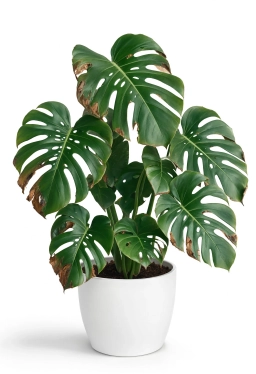
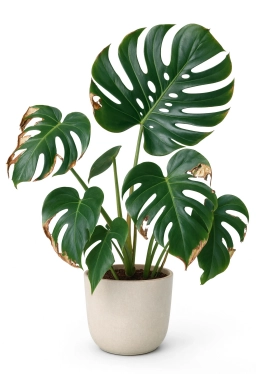
Irregular pale, bleached, or white patches develop on leaf surfaces exposed to direct sun. Affected areas become papery and dry, often with a sharp boundary between bleached and healthy tissue corresponding to shadow edges. In severe cases, the bleached zones turn brown and necrotic. Damage appears suddenly after a change in position or season — the plant's existing leaves have no photoprotective pigments calibrated for higher light intensity.
Potential Causes
- 1Sudden transition from a low-light position to direct or intense indirect sun without acclimatisation
- 2Seasonal increase in solar angle and intensity in late spring/summer reaching previously shaded areas
- 3Reflective surfaces (mirrors, white walls) concentrating light intensity beyond the plant's tolerance
- 4Glass magnifying effect — south or west-facing windows can focus infrared radiation onto leaves in afternoon hours
Solution Steps
- 1Immediately move the plant away from direct sun to bright, diffuse indirect light.
- 2Apply a sheer curtain or shade cloth (30–50% shade factor) to filter intense midday and afternoon sun.
- 3Do not remove damaged leaves immediately — they still photosynthesize and provide structural shade to recovering tissue. Remove once clearly dead.
- 4Increase watering frequency slightly in the short term — scorched plants transpire more through damaged cuticle.
- 5When acclimatising shade-adapted plants to higher light, use a gradual protocol: increase exposure by 30–60 minutes per day over 2–3 weeks.
- 6Mist the area around the plant (not the leaves directly) to reduce radiant heat on sunny days.
Prevention Tip
Calatheas, Marantas, and ferns evolved on the forest floor and are architecturally designed for dappled, filtered light not exceeding 1,000–2,000 lux. Position them 1–2 metres back from east-facing windows, or directly beside north-facing windows for year-round protection from direct sun.
Related Issues to Explore

Etiolation — Leggy, Weak Growth from Insufficient Light
Moving an etiolated plant directly into bright sun to correct light deficiency causes immediate scorch — always increase light gradually over 2–3 weeks.
Read guide
Brown, Crispy Leaf Tips — Low Humidity & Salt Stress
Scorched plants lose water rapidly through their damaged cuticle — increased transpiration quickly triggers humidity-related tip burn as a secondary issue.
Read guide
Powdery Mildew — Erysiphe & Golovinomyces spp.
Photooxidative stress weakens cell walls and reduces the plant's resistance to fungal infection — scorched plants are highly susceptible to mildew in the days following damage.
Read guide