 ⚠ Moderate
Aphids cluster on the softest new growth, deforming emerging leaves and coating foliage below with honeydew that attracts ants and sooty mould.
Aphid Colonies — Sap-Sucking on New Growth
Commonly affects: Syngonium podophyllum, Philodendron hederaceum, Monstera deliciosa, Alocasia spp.
Clusters of small, pear-shaped insects — green, black, or pale yellow — congregate on tender new growth, unfurling leaves, and flower spathes. Feeding causes curled, distorted, and stunted new leaves, and a glossy sticky honeydew coats lower foliage, attracting ants and fostering black sooty mould. Aphids reproduce explosively, with live young born ready to feed within days.
The short answer
Clusters of small soft-bodied insects on new growth and flower buds are aphids. They are the easiest common pest to remove — a firm spray of water knocks most of a colony off and they cannot climb back — but they reproduce without mating, so a handful left behind rebuilds the population in a week. Rinse, treat, and check every few days for a fortnight.
Confirm it before you treat it
- 1Look at the newest growth. Aphids concentrate on soft tissue — growing tips, flower buds and the undersides of young leaves — and rarely bother with mature foliage.
- 2Check the colour range. They come in green, black, pink, grey and white, so colour is not diagnostic; the pear-shaped body and the two small tubes at the rear are.
- 3Feel the leaves below the colony. Sticky honeydew is often the first thing noticed, sometimes with black sooty mould growing on it.
- 4Look for ants. Ants farm aphids for honeydew and actively protect them — a trail of ants up a stem usually means aphids above.
- 5Check for cast skins. Pale empty husks stuck to the leaves indicate an established, actively moulting population rather than a few arrivals.
Potential Causes
- 1Soft, nitrogen-rich new growth providing an ideal feeding substrate
- 2Introduction via new plants, cut flowers, or open windows in warm weather
- 3Absence of natural predators in the indoor environment allowing unchecked reproduction
- 4Ant activity actively protecting and farming aphid colonies for honeydew
Solution Steps
- 1Dislodge the bulk of the colony with a firm spray of lukewarm water, focusing on growing tips and leaf undersides.
- 2Apply insecticidal soap or a neem oil spray to all affected surfaces, repeating every 4–5 days until no live aphids remain.
- 3For light infestations, wipe colonies away by hand with a soapy damp cloth.
- 4Address any ant trails simultaneously — ants will re-seed aphid colonies if left unmanaged.
- 5Prune badly distorted growing tips that are unlikely to recover their form.
- 6Inspect the plant every few days for two weeks, as a few survivors can rebuild a colony rapidly.
What else looks like this
| Could be | How to tell it apart |
|---|---|
| Whitefly | Flies up in a cloud when the plant is disturbed. Aphids stay put — they are slow and largely sedentary. |
| Mealybug | White and waxy, tucked into leaf joints. Aphids are smooth-bodied and cluster in the open on stems and buds. |
| Thrips | Slim, fast-moving, and leaves silvery streaks. Aphids leave no streaking — the damage is distortion and stickiness. |
| Scale insects | Hard immobile bumps fixed to stems. Aphids can be brushed off with a finger; scale has to be scraped. |
| Nutrient-related leaf curl | Distortion with no insects present. Aphid damage always has the colony somewhere on the affected growth, usually underneath. |
Recovery timeline
- Day 1Rinse the plant firmly under a shower or with a hose, focusing on growing tips and leaf undersides. This alone removes the majority.
- Days 3–4Check again. Survivors will have started new colonies on fresh growth — rinse or spot-treat now, before they build.
- Week 1Second full treatment. Aphid generations take about a week indoors, so this catches the offspring of anything missed.
- Week 2Populations should be minimal. New growth emerging undistorted is the sign that matters.
- OngoingCheck new growth weekly during active growing season, and deal with any ant trails — ants will reintroduce aphids deliberately.
If you do nothing
Aphids reproduce parthenogenetically, meaning a single female produces live young without mating, and those young mature in about a week. A colony compounds very fast. Feeding distorts new growth permanently, buds abort, and the honeydew grows sooty mould that blocks light from the leaves beneath. They are also among the most efficient plant virus vectors, and several of the viruses they carry have no treatment at all.
Common mistakes
- Treating the leaves you can see and ignoring the growing tip. That is where the colony actually lives and where the next generation appears.
- Using a strong insecticide first. A water rinse removes most of the population with no chemical at all, and works on any plant.
- Ignoring ants. As long as ants are farming the colony, they will defend it and move survivors to new growth.
- Stopping after one clean check. A week later, anything missed has produced a new generation.
- Treating outdoors indiscriminately. Ladybirds, lacewings and parasitic wasps eat aphids in quantity, and a broad-spectrum spray removes those too.
Prevention Tip
Avoid heavy nitrogen feeding during active growth flushes — the soft, sappy tissue it produces is exactly what aphids target. Rinse new growth periodically and keep ants out of the grow area to remove the colonies' protectors.
Questions people actually ask
- Where did they come from?
- Open windows, new plants, or cut flowers. Winged forms fly in during warm weather specifically to found new colonies.
- Does soapy water work?
- Yes — a mild insecticidal soap breaks down their outer coating on contact. It has no residual effect, so it must physically hit the insects and be repeated.
- Should I remove the distorted leaves?
- Only if heavily curled, since curled leaves shelter survivors from any spray. The distortion itself is permanent but harmless.
- Are they dangerous to other plants?
- Yes. Winged forms develop specifically when a colony gets crowded, and their purpose is to find new host plants.
- What about ladybirds indoors?
- Effective in a greenhouse or conservatory. In an ordinary room they tend to leave in search of light and better prospects.
Related Issues to Explore

Mealybug Infestation — Pseudococcus spp.
Both aphids and mealybugs are soft-bodied sap-feeders that excrete honeydew — distinguish them by mobility and the mealybug's white waxy coat.
Read guide
Thrips Infestation — Silvery Stippling & Black Frass
Thrips and aphids both attack tender new growth — a shared inspection-and-quarantine routine catches both before they distort emerging leaves.
Read guide
Whitefly — Trialeurodes Clouds on Undersides
Whiteflies share the honeydew-and-sooty-mould pattern with aphids — check leaf undersides and watch for clouds of tiny white insects when disturbed.
Read guideMore Pest Infestations Problems
See all →
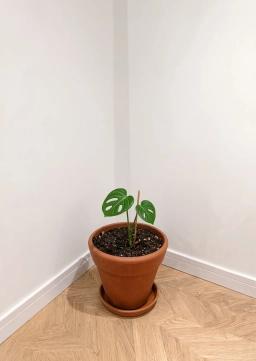
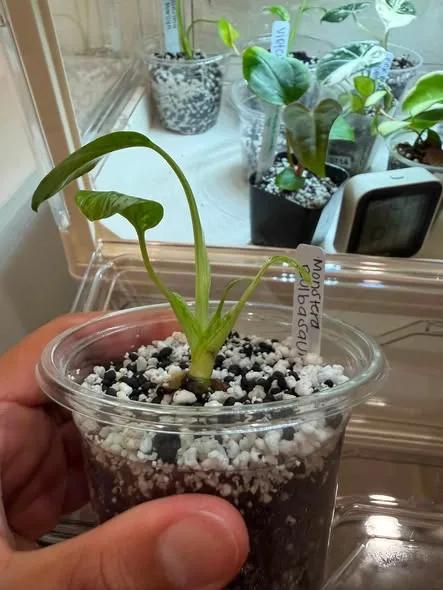
Real Monstera grow diaries
Growers on DailyGrowers log their plant week by week, one photo at a time. Here's how theirs are going.
Growing Monstera too? Start your own diary. It's free and takes 2 minutes.
Start my Monstera diary →