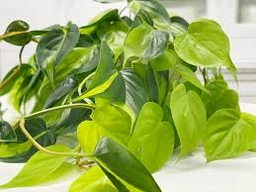
 ⚠ Critical
Fine silken webbing linking leaf axils and stems — a definitive marker of established Tetranychus urticae colony activity; inspect undersides of stippled leaves for mite colonies.
Spider Mite Infestation — Tetranychus urticae
Commonly affects: Most indoor tropical foliage, particularly Ficus lyrata, Alocasia, Dracaena, Orchids
Fine, stippled yellow or bronze speckling appears on upper leaf surfaces as mites pierce individual cells to feed. Infestations progress to visible webbing beneath leaves and between stems, giving a dusty, silken appearance. Severely affected leaves turn bronze-brown and desiccate. Spider mites thrive in hot, dry conditions and reproduce extremely rapidly — a single female can lay 300 eggs over her lifespan.
The short answer
Fine pale stippling on the leaves with faint webbing where the leaf meets the stem is spider mites. They thrive in warm, dry air, which is why infestations explode in heated rooms in winter. One treatment never works — the eggs are unaffected by almost everything you can spray, so plan on three treatments five to seven days apart and isolate the plant while you do it.
Confirm it before you treat it
- 1Hold a leaf up to the light. Spider mite damage is a fine pale speckling, like the colour has been lifted out in pinpricks, rather than solid patches or spots.
- 2Look at the underside with a phone camera zoomed in. Adults are barely a moving dot; you are looking for movement more than shape.
- 3Tap a leaf over a sheet of white paper. Mites fall off and look like specks of dust that walk.
- 4Check the leaf axils and growing tips for fine webbing. Webbing means the population is already large — it is a late sign, not an early one.
- 5Inspect every plant within touching distance. Mites travel by contact and by air currents, and treating one plant in a group simply hands the problem back and forth.
Potential Causes
- 1Low humidity (below 40%) and warm temperatures (above 26°C) creating ideal mite breeding conditions
- 2Plants stressed by drought, nutrient deficiency, or root problems becoming more susceptible
- 3Introduction of infested plants or cut flowers nearby without quarantine
- 4Dusty leaf surfaces enabling mites to move and anchor without disturbance
Solution Steps
- 1Isolate the affected plant immediately from all other houseplants to prevent spread.
- 2Take the plant to a sink or shower and spray every surface — top and underside of leaves, stems, and soil surface — with a strong stream of lukewarm water. This mechanically removes up to 80% of mites.
- 3Prepare a neem oil spray: 5 ml cold-pressed neem oil, 2 ml castile soap, 1 litre warm water. Shake vigorously and apply to all leaf surfaces, including undersides.
- 4Repeat the neem oil treatment every 3 days for three cycles to break the egg-to-adult lifecycle (approximately 7–10 days at 25°C).
- 5Increase ambient humidity to 60%+ — spider mites cannot reproduce effectively above 70% RH.
- 6Introduce predatory mites (Phytoseiulus persimilis) as biological control for severe infestations.
What else looks like this
| Could be | How to tell it apart |
|---|---|
| Thrips | Silvery or bronze streaks rather than fine dots, plus small black specks of frass. Thrips damage looks smeared; mite damage looks stippled. |
| Underwatering | Whole-leaf dullness and crisp edges with no discrete dots and nothing on the underside. Improves within a day of watering, which mite damage does not. |
| Nutrient deficiency | Yellowing follows the veins in a pattern; mite stippling ignores veins entirely and is denser near the leaf base. |
| Dust or hard-water spots | Sits on the surface and wipes off with a damp cloth. Mite damage is in the leaf tissue and does not. |
| Sun scorch | Bleached patches on the side facing the light, appearing within days of a move. Mites work from the underside and spread regardless of orientation. |
Recovery timeline
- Day 1Isolate the plant, rinse both leaf surfaces under a shower, then treat. Physically removing most of the population first makes everything after it work better.
- Days 5–7Second treatment. Eggs laid before the first one are hatching now, so seeing live mites is expected and does not mean the treatment failed.
- Days 12–14Third treatment. This is the one that catches the last hatch, and the one most people skip.
- Weeks 3–4No new stippling on new leaves. Existing damage stays — mite-damaged tissue never recovers its colour, so judge by new growth only.
- OngoingRaise humidity and check monthly. Mite generations take under a week at 27 °C, so a small missed population rebuilds quickly.
If you do nothing
Spider mites reproduce fast enough to double a population in under a week in warm, dry conditions. Feeding removes chlorophyll cell by cell until the leaf can no longer photosynthesise, at which point it browns and drops. A heavily infested plant loses most of its foliage in four to six weeks, and by then the mites have moved to every plant within reach. They are one of the few houseplant pests that routinely kill an established plant outright.
Common mistakes
- Treating once and stopping. Nothing you can spray reliably kills the eggs, so a single treatment removes the adults and leaves the next generation intact.
- Spraying only the top of the leaves. Mites live and feed on the underside; a top-only spray misses almost the entire population.
- Not isolating the plant. Mites move between touching leaves within hours, so treating one plant in a crowded shelf achieves very little.
- Assuming dry brown leaves mean it worked. Damaged tissue does not recover — judge success on whether NEW leaves come in clean.
- Leaving the room warm and dry. Central heating in winter creates exactly the conditions mites need, which is why most indoor outbreaks start in autumn.
Prevention Tip
Wipe leaf surfaces monthly with a damp microfibre cloth to remove dust and disrupt mite colonies before they establish. Regular misting or a nearby humidifier maintains the humidity level that deters spider mites.
Questions people actually ask
- Where did they come from?
- Almost always a newly bought plant, a bunch of cut flowers, or an open window in summer. They are too small to notice on arrival and are usually present for weeks before the stippling shows.
- Does neem oil work?
- Yes, as a contact treatment, and it also deters egg-laying. It still needs repeating at 5–7 day intervals, and it must reach the leaf undersides.
- Will raising humidity alone fix it?
- It slows them considerably and helps prevent recurrence, but it will not clear an established population on its own.
- Are the damaged leaves worth removing?
- Only if a leaf is more than about half damaged. A partly stippled leaf still photosynthesises, and stripping foliage weakens a plant already under stress.
- Can they spread to me or my pets?
- No. Spider mites feed only on plants and cannot bite or live on animals.
Related Issues to Explore

Powdery Mildew — Erysiphe & Golovinomyces spp.
Both spider mites and powdery mildew thrive in warm, dry conditions — treating one without improving humidity often allows the other to follow.
Read guide
Bacterial & Fungal Leaf Spot — Xanthomonas & Cercospora spp.
Mite stippling and bacterial spots both damage leaf surfaces — confirm the cause by checking for webbing (mites) vs. water-soaked halos (bacterial).
Read guide
Etiolation — Leggy, Weak Growth from Insufficient Light
Light-stressed plants are significantly more susceptible to mite infestation — correcting the light environment reduces stress and pest pressure simultaneously.
Read guideMore Pest Infestations Problems
See all →
Real Monstera grow diaries
Growers on DailyGrowers log their plant week by week, one photo at a time. Here's how theirs are going.
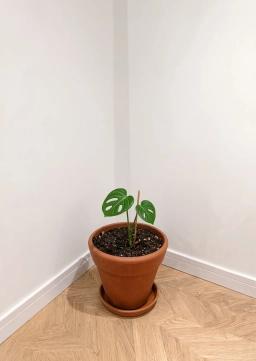
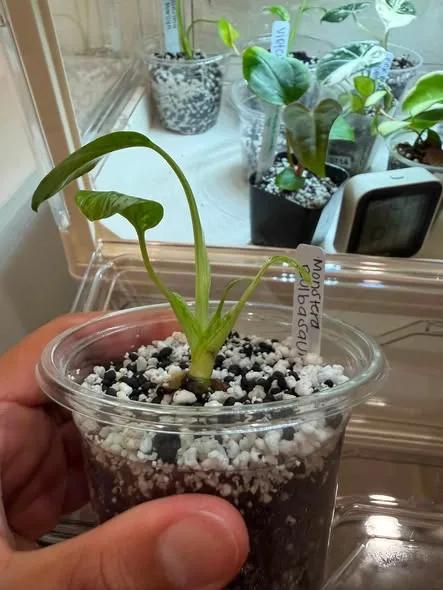
Growing Monstera too? Start your own diary. It's free and takes 2 minutes.
Start my Monstera diary →