 ⚠ Moderate
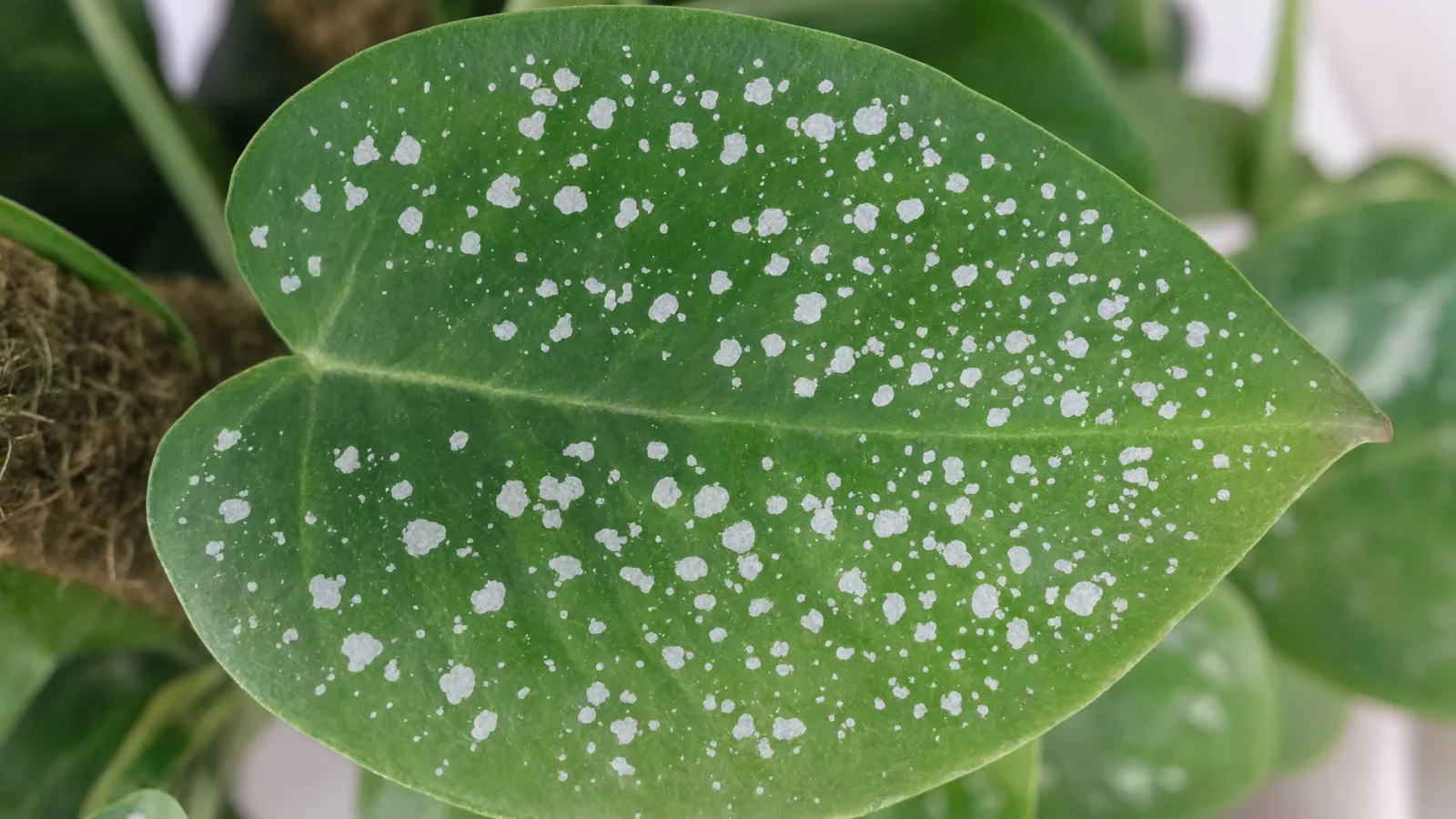
Erysiphe and Golovinomyces spp. form a superficial white mycelial coating on the adaxial leaf surface — visually resembling a fine white powder or crystalline dusting.
Powdery Mildew — Erysiphe & Golovinomyces spp.
Commonly affects: Begonia rex, Kalanchoe blossfeldiana, Ficus benjamina, Succulent varieties
A white to grey powdery coating appears on leaf surfaces, stems, and occasionally flower buds. Unlike other fungal diseases, powdery mildew grows on the surface rather than inside plant tissue, giving it a dusted-flour appearance. Affected tissue may yellow beneath the coating. Unlike downy mildew, it occurs on the upper leaf surface and does not require standing water — in fact, it thrives in dry conditions with high humidity.
The short answer
A white dusty film on the upper leaf surface that rubs off with a finger is powdery mildew. Unlike most fungal problems it does not need wet leaves — it needs still, humid air and crowded foliage, which is why it appears on plants that are never misted. Improve airflow first, remove the worst leaves, and treat with a milk or potassium bicarbonate spray; it responds quickly when the conditions change.
Confirm it before you treat it
- 1Rub a white patch with a fingertip. Powdery mildew smears and lifts; mineral deposits and pest residue do not.
- 2Check which surface it is on. Powdery mildew starts on the upper surface of older, shaded leaves. Downy mildew, which is far more serious, appears underneath.
- 3Look at the air rather than the plant. Crowded foliage, a corner with no movement, or a room that is humid but cool are the conditions that produce it.
- 4Look for distortion in new growth. Infected young leaves curl and stay small, which distinguishes an active spreading infection from old cosmetic damage.
- 5Check neighbouring plants. Spores travel on air currents, so an outbreak usually involves several plants that share still air.
Potential Causes
- 1High humidity combined with poor air circulation creating a boundary layer of stagnant moist air around foliage
- 2Overcrowded growing conditions preventing air movement between leaves
- 3Moderate temperatures (15–26°C) with fluctuating humidity — the classic greenhouse-window environment
- 4Weakened plants from nutrient stress, root issues, or extreme temperatures becoming more susceptible
Solution Steps
- 1Isolate the affected plant immediately and remove visibly infected leaves — place them directly into a sealed bag, not the compost.
- 2Prepare a baking soda spray: 1 tsp sodium bicarbonate, ½ tsp liquid castile soap, 1 litre water. Apply to all leaf surfaces — the alkaline pH disrupts spore germination.
- 3Alternatively, dilute apple cider vinegar (2 tbsp per litre of water) and apply as a foliar spray — acidity similarly inhibits mildew growth.
- 4For persistent infections, apply a registered sulphur-based fungicide according to label instructions.
- 5Improve air circulation around the plant using a small fan on low setting.
- 6Reduce leaf wetting during watering — water the substrate directly, never overhead.
What else looks like this
| Could be | How to tell it apart |
|---|---|
| Downy mildew | Fuzzy grey or purplish growth on the leaf UNDERSIDE with yellow patches above. Far more damaging and needs different treatment — the surface it grows on is the fastest way to tell them apart. |
| Hard-water residue | White marks that follow droplet edges, do not spread, and wipe off completely with a damp cloth leaving nothing behind. |
| Mealybug | Discrete cottony lumps in leaf joints rather than a flat film across the leaf surface. Mealybugs have a shape; mildew has an area. |
| Edema | Raised corky blisters, not powder. Caused by the plant taking up water faster than it can transpire, and it does not spread between plants. |
| Trichomes on a fuzzy-leaved plant | Even coverage present from the moment the leaf unfurls, uniform across every leaf, and it does not rub away. |
Recovery timeline
- Day 1Remove the worst-affected leaves, open up airflow, and apply the first treatment. Do not bag pruned leaves near other plants — spores travel.
- Days 2–4Existing patches stop expanding. They do not disappear; treated mildew dries and stays visible as a dull mark.
- Week 1Second treatment. New leaves emerging clean is the signal that matters.
- Weeks 2–3No new patches. If they are still appearing, the airflow has not actually changed and the treatment is fighting the conditions rather than the fungus.
- OngoingKeep plants spaced and air moving. Powdery mildew recurs reliably in the same spot in a room, and reliably does not where air moves.
If you do nothing
The fungus covers progressively more leaf surface, and every square centimetre it covers is a square centimetre that has stopped photosynthesising. Growth slows, leaves yellow and drop from the bottom up, and flowering or fruiting stops. It is rarely fatal to an established houseplant but will halt a seedling or a cutting entirely, and on edibles it substantially reduces yield.
Common mistakes
- Misting the plant to 'wash it off'. Raising humidity around still foliage is precisely what powdery mildew wants.
- Treating without changing the conditions. Any spray suppresses an outbreak; only airflow prevents the next one.
- Using a broad fungicide on an edible without checking the label. Many are not approved for food crops, and the ones that are have harvest intervals.
- Removing every affected leaf at once. Stripping a plant to bare stems weakens it more than the fungus was going to.
- Composting infected leaves in an open pile near plants. Spores survive and return.
Prevention Tip
A preventive spray of dilute potassium silicate (0.5 g/L) applied monthly strengthens cell walls and measurably reduces powdery mildew susceptibility. Silicon supplementation is particularly effective for Begonias, which are chronically prone.
Questions people actually ask
- Does the milk spray actually work?
- Yes, surprisingly well, at roughly one part milk to nine parts water on a bright day. The mechanism is not fully settled but the effect is well documented on cucurbits and roses.
- Is it the same fungus on every plant?
- No. Powdery mildew is a family of host-specific fungi, so the one on your cucumbers will not usually move to your monstera. It looks identical either way.
- Can I eat produce from an affected plant?
- Yes. Wash it well. The fungus affects yield and flavour rather than safety.
- Why does it keep coming back in the same spot?
- Because the spot has not changed — a corner with no air movement will produce it again every season regardless of how well you treat the plant.
- Will removing affected leaves cure it?
- It reduces the spore load significantly and is worth doing, but spores are already airborne, so it works as part of a treatment rather than instead of one.
Related Issues to Explore

Bacterial & Fungal Leaf Spot — Xanthomonas & Cercospora spp.
Both powdery mildew and leaf spot pathogens spread in humid, poorly ventilated conditions — the same environmental corrections treat both risks simultaneously.
Read guide
Spider Mite Infestation — Tetranychus urticae
Nutrient-stressed plants susceptible to mildew are also prime targets for spider mites — inspect undersides of leaves for stippling when mildew is confirmed.
Read guide
Stem & Crown Rot — Botrytis & Fusarium spp.
In overcrowded, humid conditions, Botrytis grey mould frequently accompanies powdery mildew — monitor stem bases carefully as humidity increases.
Read guideMore Fungal & Bacterial Disease Problems
See all →

Real Monstera grow diaries
Growers on DailyGrowers log their plant week by week, one photo at a time. Here's how theirs are going.
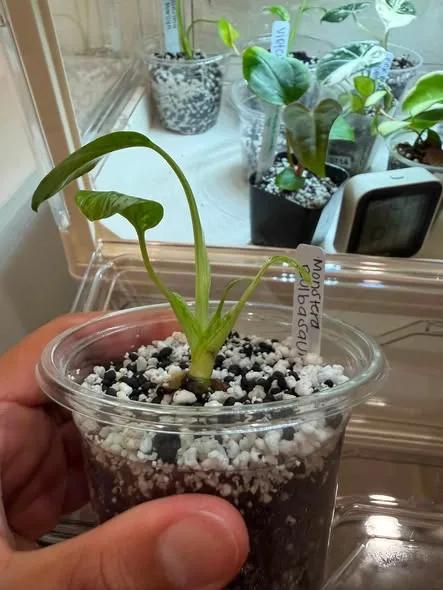
Growing Monstera too? Start your own diary. It's free and takes 2 minutes.
Start my Monstera diary →