 ⚠ Minor
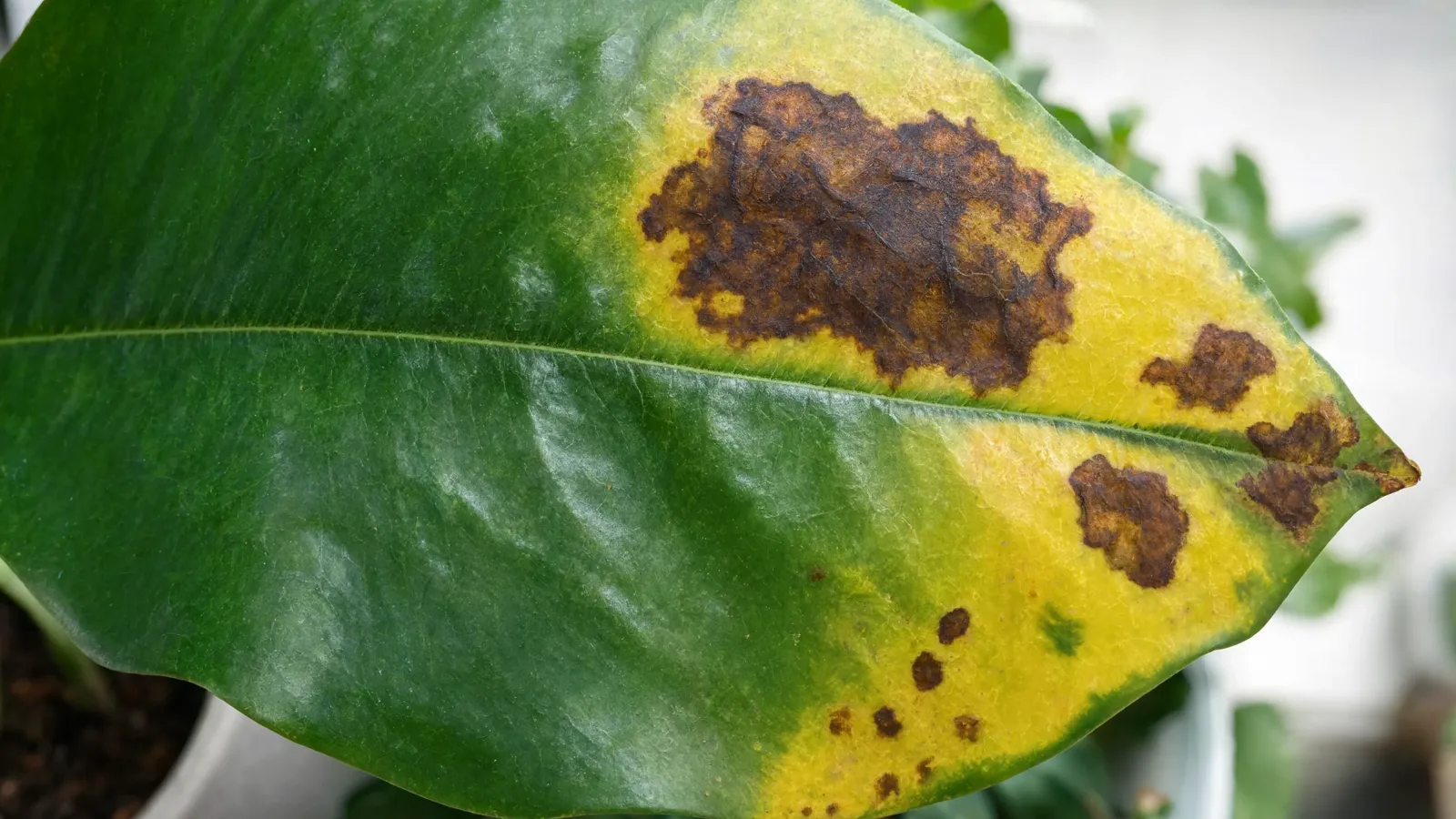
Papery, desiccated leaf margins progressing symmetrically inward from the tips — characteristic of transpirational water loss exceeding root uptake under sub-optimal humidity.
Brown, Crispy Leaf Tips — Low Humidity & Salt Stress
Commonly affects: Calathea orbifolia, Spathiphyllum wallisii, Nephrolepis exaltata (Boston Fern)
Leaf tips and outer margins turn brown, dry, and brittle. The browning begins at the very tip and progresses symmetrically inward along the leaf margins. Affected tissue is desiccated — sharply distinct from the healthy green centre. In severe cases, entire outer thirds of leaves are brown and paper-thin.
Potential Causes
- 1Relative humidity consistently below 40–50%, causing excessive transpiration at leaf margins
- 2Salt and mineral accumulation from tap water or excess fertiliser building up in the substrate
- 3Direct air flow from heating vents, air conditioners, or fans desiccating leaf tissue
- 4Inconsistent watering — allowing the root zone to dry out completely and repeatedly stresses sensitive hygrometer-dependent species
Solution Steps
- 1Increase local humidity to 55–70% using a room humidifier placed 30–50 cm from the plant.
- 2Group the plant with other tropical species to create a microclimate with elevated humidity through collective transpiration.
- 3Flush the pot thoroughly with clean, room-temperature water — pour slowly until water runs freely from drainage holes for 2–3 minutes to leach accumulated salts.
- 4Switch to filtered, rainwater, or distilled water if tap water has high mineral content (TDS > 200 ppm).
- 5Relocate the plant away from heating vents, fans, and exterior doors.
- 6Trim brown tips with clean, sharp scissors at a slight angle to mimic the natural leaf shape — do not cut into live green tissue.
Prevention Tip
Calatheas, ferns, and Peace Lilies are highly sensitive to fluoride and chlorine in tap water. Leave water in an open container for 24 hours before use to off-gas chlorine, or collect and use rainwater where possible.
Related Issues to Explore

Sun Scorch & Leaf Bleaching — Photooxidative Damage
Sharp-edged bleached patches caused by sudden intense sun exposure — often confused with tip burn but distinguished by irregular placement on the leaf blade.
Read guide
Interveinal Chlorosis — Iron or Magnesium Deficiency
Magnesium deficiency causes yellowing from old leaves upward — easily confused with humidity stress but distinguished by the interveinal pattern.
Read guide
Yellowing Leaves — Overwatering Stress
Inconsistent watering causes both crispy tips and generalised yellowing — check substrate moisture and root condition if both symptoms appear simultaneously.
Read guide