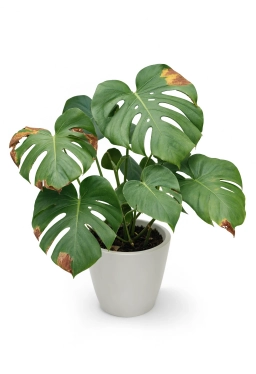
 ⚠ Critical
Thrips rasp the epidermis and feed on escaping sap, leaving silvery scarring and pinpoint black frass — most severe in the youngest, still-furled leaves.
Thrips Infestation — Silvery Stippling & Black Frass
Commonly affects: Monstera deliciosa, Anthurium andraeanum, Philodendron erubescens, Alocasia amazonica
Leaves develop silvery-grey or bronze patches with a papery sheen as thrips rasp the surface and feed on the released cell sap. Tiny black specks of frass (excrement) dot the affected areas, and new growth emerges distorted, scarred, or curled. Thrips are slender, 1–2 mm insects that move rapidly when disturbed and hide along veins and within unfurling leaves.
The short answer
Silvery or bronze streaks on the leaves with tiny black specks are thrips. They are the most persistent common houseplant pest, because they feed inside developing leaves where sprays cannot reach and part of their life cycle happens in the soil. Expect a month of weekly treatment, treat the substrate as well as the foliage, and judge success only by whether new leaves come in clean.
Confirm it before you treat it
- 1Look for the streaks, not the insect. Thrips damage is silvery, slightly metallic and follows the leaf grain — quite unlike the round dots of mite damage.
- 2Find the black specks. Thrips frass looks like scattered pepper on the leaf and is often easier to spot than the insects themselves.
- 3Shake a leaf over white paper. Adults are slim yellow-brown slivers, about 1–2 mm, that move quickly when disturbed.
- 4Open a new unfurling leaf carefully. Thrips feed on tissue before it expands, which is why damage often appears on leaves that looked perfect yesterday.
- 5Put up a blue sticky trap. Thrips are drawn to blue rather than yellow, and traps confirm whether a population is still active during treatment.
Potential Causes
- 1Introduction of infested plants, cut flowers, or fresh produce without quarantine
- 2Warm, dry indoor conditions accelerating the thrips reproductive cycle
- 3Dense foliage and tightly furled new growth providing protected feeding and egg-laying sites
- 4Outdoor migration through open windows during warm months
Solution Steps
- 1Isolate the affected plant immediately — thrips fly and spread rapidly across a collection.
- 2Rinse all leaf surfaces, including undersides and leaf axils, with a firm spray of lukewarm water to dislodge active insects.
- 3Apply a spinosad-based insecticide or a neem oil spray (5 ml neem, 2 ml castile soap, 1 litre water) to all surfaces, repeating every 5–7 days for three cycles.
- 4Set blue sticky traps near the canopy to capture winged adults and monitor population levels.
- 5Wipe down nearby surfaces, pots, and saucers where pupae may shelter in soil or debris.
- 6Prune severely scarred leaves once new, clean growth establishes.
What else looks like this
| Could be | How to tell it apart |
|---|---|
| Spider mites | Fine round stippling and webbing rather than streaks and frass. Mite damage looks like pinpricks; thrips damage looks scraped. |
| Sun scorch | Bleached areas on the side facing the light, appearing suddenly after a move, with no black specks anywhere. |
| Mechanical scarring | Damage that is old, does not spread, and matches a point where the leaf rubbed against something while unfurling. |
| Nutrient deficiency | Colour change follows the veins in a pattern across the whole leaf. Thrips damage is patchy and ignores vein structure. |
| Virus | Mosaic mottling or ring patterns rather than linear streaking. Worth considering if damage continues after thrips are demonstrably gone — thrips are also a virus vector. |
Recovery timeline
- Day 1Isolate, rinse thoroughly, treat foliage and drench the substrate. Skipping the soil is the single most common reason thrips treatment fails.
- Days 5–7Second treatment. Larvae that were inside leaf tissue during the first pass have now emerged.
- Days 12–14Third treatment. Pupae in the soil from the first generation are becoming adults around now.
- Weeks 3–4Fourth treatment, and the point at which new growth should be emerging undamaged. Old damage stays permanently.
- Weeks 5–8Keep the blue traps up. Thrips reappear from soil pupae weeks after the foliage looks clean, and a trap catches that before the leaves show it.
If you do nothing
Thrips feed by rasping the leaf surface and draining the cells, so affected tissue never recovers and the plant loses photosynthetic area permanently. New growth emerges scarred and distorted, flowers abort, and the plant declines steadily over months. They also transmit tospoviruses, which are incurable — an untreated infestation risks a problem considerably worse than the insects themselves.
Common mistakes
- Treating the leaves only. Thrips pupate in the substrate, so a foliage-only routine leaves half the population untouched and guarantees a return.
- Stopping after two treatments. The life cycle runs two to three weeks, and four weekly passes is the realistic minimum.
- Judging by old damage. Existing streaks never heal — success is measured entirely by whether NEW leaves emerge clean.
- Keeping the plant with the others. Thrips fly, and an infested plant in a group means treating the whole group.
- Relying on a single product. Thrips develop resistance quickly; alternating between two modes of action works better than escalating the dose of one.
Prevention Tip
Quarantine every new plant for at least 14 days and inspect unfurling leaves with a hand lens — thrips damage almost always begins in the newest, most tender growth. Blue sticky cards left permanently in the grow area give early warning of any reintroduction.
Questions people actually ask
- Why do thrips keep coming back?
- Almost always because the soil was not treated. Pupae sit in the substrate through every foliar spray and emerge a week or two later.
- Will damaged leaves recover?
- No. The scarring is destroyed tissue and remains for the life of the leaf. Remove leaves only if most of the surface is gone.
- Are sticky traps useful?
- Yes — use blue rather than yellow. They will not control an infestation but they tell you reliably whether one is still active.
- Do they bite people?
- They can land on skin and occasionally give a very slight prickle, but they do not feed on people and cannot live indoors away from plants.
- Should I repot to get rid of the soil stage?
- It helps considerably in a bad infestation, provided you remove as much old mix as possible and wash the pot. On its own, without foliar treatment, it is not enough.
Related Issues to Explore

Spider Mite Infestation — Tetranychus urticae
Both thrips and spider mites cause fine stippling on leaves — confirm the culprit by checking for webbing (mites) versus silvery scarring with black frass (thrips).
Read guide
Tomato Spotted Wilt & Ringspot — Thrips-Vectored Virus
Thrips are the primary vector of tospoviruses — controlling an infestation early prevents the far more serious introduction of an incurable viral disease.
Read guide
Aphid Colonies — Sap-Sucking on New Growth
Like thrips, aphids concentrate on tender new growth — a single quarantine and inspection routine controls both sap-feeding pests at once.
Read guideMore Pest Infestations Problems
See all →
Real Monstera grow diaries
Growers on DailyGrowers log their plant week by week, one photo at a time. Here's how theirs are going.
Growing Monstera too? Start your own diary. It's free and takes 2 minutes.
Start my Monstera diary →