 ⚠ Moderate
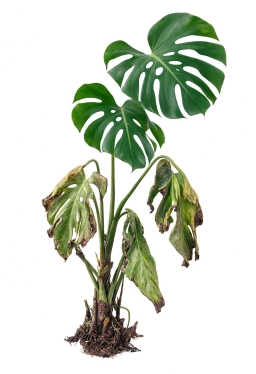
Potassium deficiency scorches the margins and tips of older leaves while the centre stays green — a mobile-nutrient pattern distinct from uniform nitrogen yellowing.
Potassium Deficiency — Marginal Scorch
Commonly affects: Monstera deliciosa, Philodendron spp., Alocasia spp., Anthurium andraeanum
Older leaves develop yellowing and browning along their margins and tips while the centre stays green, the scorched edges progressing inward and often curling. Because potassium is mobile, symptoms appear on the oldest leaves first. The pattern — a scorched margin around a green interior — distinguishes it from the uniform yellowing of nitrogen deficiency.
The short answer
Yellowing and browning that starts precisely at the leaf edges and works inward, on older leaves first, is potassium deficiency. The distinguishing feature is the margin — the edge scorches while the centre stays green. It is most common on fruiting plants, which move potassium into the fruit, and on plants watered with soft water. A tomato feed corrects it within two to three weeks.
Confirm it before you treat it
- 1Trace the pattern. Potassium scorches the leaf margin evenly all the way round, leaving the middle and the veins green. No other deficiency does that.
- 2Check which leaves. Potassium is mobile, so the plant strips old leaves first. Damage starting on new growth is a different nutrient.
- 3Note whether the plant is fruiting. Tomatoes, peppers and other fruiting crops draw heavily on potassium and show this most often during fruit fill.
- 4Rule out salt burn. Fertiliser scorch also affects margins but hits the NEWEST leaves and usually comes with a white crust on the mix.
- 5Consider your water. Very soft or reverse-osmosis water supplies almost no potassium, and plants fed only with it deplete faster.
Potential Causes
- 1Depleted potassium in exhausted or unfertilised substrate
- 2Heavy leaching from frequent watering removing mobile potassium
- 3Imbalanced fertiliser low in potassium relative to nitrogen
- 4Excess calcium or magnesium competing with potassium uptake
Solution Steps
- 1Apply a balanced fertiliser with adequate potassium (the 'K' in NPK) at the correct dilution.
- 2Correct any fertiliser imbalance that is overloading nitrogen at potassium's expense.
- 3Repot into fresh substrate if the mix is old and nutrient-depleted.
- 4Flush the substrate first if salt build-up may be hindering uptake, then resume balanced feeding.
- 5Maintain consistent feeding through the growing season to prevent recurrence.
- 6Trim badly scorched leaf margins for appearance; new growth should emerge normal.
What else looks like this
| Could be | How to tell it apart |
|---|---|
| Fertiliser or salt burn | Crisp brown margins on the NEWEST leaves, often with white deposits on the soil surface. Potassium deficiency works on the oldest leaves. |
| Underwatering | Crisping at tips and margins across the whole plant at once, with dry mix, and it improves within a day of watering. |
| Magnesium deficiency | Yellowing BETWEEN the veins in a marbled pattern, with the margin often still green — almost the mirror image of potassium. |
| Low humidity | Brown crisp tips rather than a continuous margin, and it affects thin-leaved tropicals rather than fruiting crops. |
| Bacterial leaf scorch | Irregular browning with a yellow halo, not a clean even margin, and it usually spreads along a branch rather than across leaves of one age. |
Recovery timeline
- Days 1–3Feed with a high-potassium fertiliser — a tomato feed is the easiest source. Water it in thoroughly rather than applying to dry mix.
- Week 1No visible change. Damaged margins are dead tissue and stay brown for the life of the leaf.
- Weeks 2–3New leaves emerge with clean margins. This is the confirmation; the old leaves are not the measure.
- Weeks 4–6Fruit fill improves visibly on fruiting plants, and fruit quality along with it.
- OngoingKeep feeding through fruiting. Potassium demand peaks while fruit is swelling, and that is exactly when deficiency reappears.
If you do nothing
Potassium regulates water movement and the plant's stomata, so a deficient plant loses control of transpiration and becomes far more vulnerable to both drought and disease. Leaf margins die back progressively, older leaves are shed, and photosynthetic area falls. On fruiting crops the fruit stays small, ripens unevenly and tastes poor — potassium is directly responsible for sugar transport into fruit, so a deficient tomato is a bland one.
Common mistakes
- Using a balanced feed on a fruiting plant. Fruiting crops need considerably more potassium than nitrogen once flowering starts.
- Confusing it with salt burn and flushing the pot. Flushing removes what little potassium is left and makes it worse.
- Waiting for old leaves to recover. Dead margin tissue never regreens; only new growth shows whether the correction worked.
- Adding wood ash liberally. It supplies potassium but also raises pH sharply, which locks out iron and manganese and creates a second problem.
- Feeding without watering in. Dry fertiliser sitting on dry mix does nothing and can scorch roots when the plant is next watered.
Prevention Tip
A balanced complete fertiliser supplies potassium alongside nitrogen and phosphorus — deficiency usually reflects an exhausted mix or a lopsided feed. Refresh substrate periodically and avoid heavy nitrogen-only feeding that drives potassium out of balance.
Questions people actually ask
- Is a tomato feed suitable for non-tomato plants?
- Yes. It is simply a high-potassium formula and works for any flowering or fruiting plant showing this pattern.
- How is this different from fertiliser burn?
- Age of leaf. Potassium deficiency starts on the oldest leaves; salt burn starts on the newest, because that is where the salts are being carried.
- Can I use banana peels?
- They contain potassium but release it far too slowly and unevenly to correct an active deficiency. Useful in compost, not as a treatment.
- Why did it appear suddenly during fruiting?
- Because fruit is where potassium goes. Demand can triple during fruit fill, and a soil level that was adequate before becomes deficient overnight.
- Should I remove the scorched leaves?
- Only if a leaf is mostly brown. The green portion is still working, and removing too much reduces the plant's capacity further.
Related Issues to Explore

Nitrogen Deficiency — Uniform Pale Older Leaves
Both affect older leaves first as mobile nutrients — nitrogen yellows uniformly, while potassium scorches the margins.
Read guide
Brown, Crispy Leaf Tips — Low Humidity & Salt Stress
Marginal scorch from potassium deficiency resembles humidity- and salt-related tip burn — the deficiency starts on the oldest leaves specifically.
Read guide
Salt Crust & EC Build-Up in Substrate
Salt build-up can both mimic and cause potassium problems by impairing uptake — flushing the substrate is a shared first step.
Read guideMore Colour Changes Problems
See all →
Real Monstera grow diaries
Growers on DailyGrowers log their plant week by week, one photo at a time. Here's how theirs are going.
Growing Monstera too? Start your own diary. It's free and takes 2 minutes.
Start my Monstera diary →