 ⚠ Critical
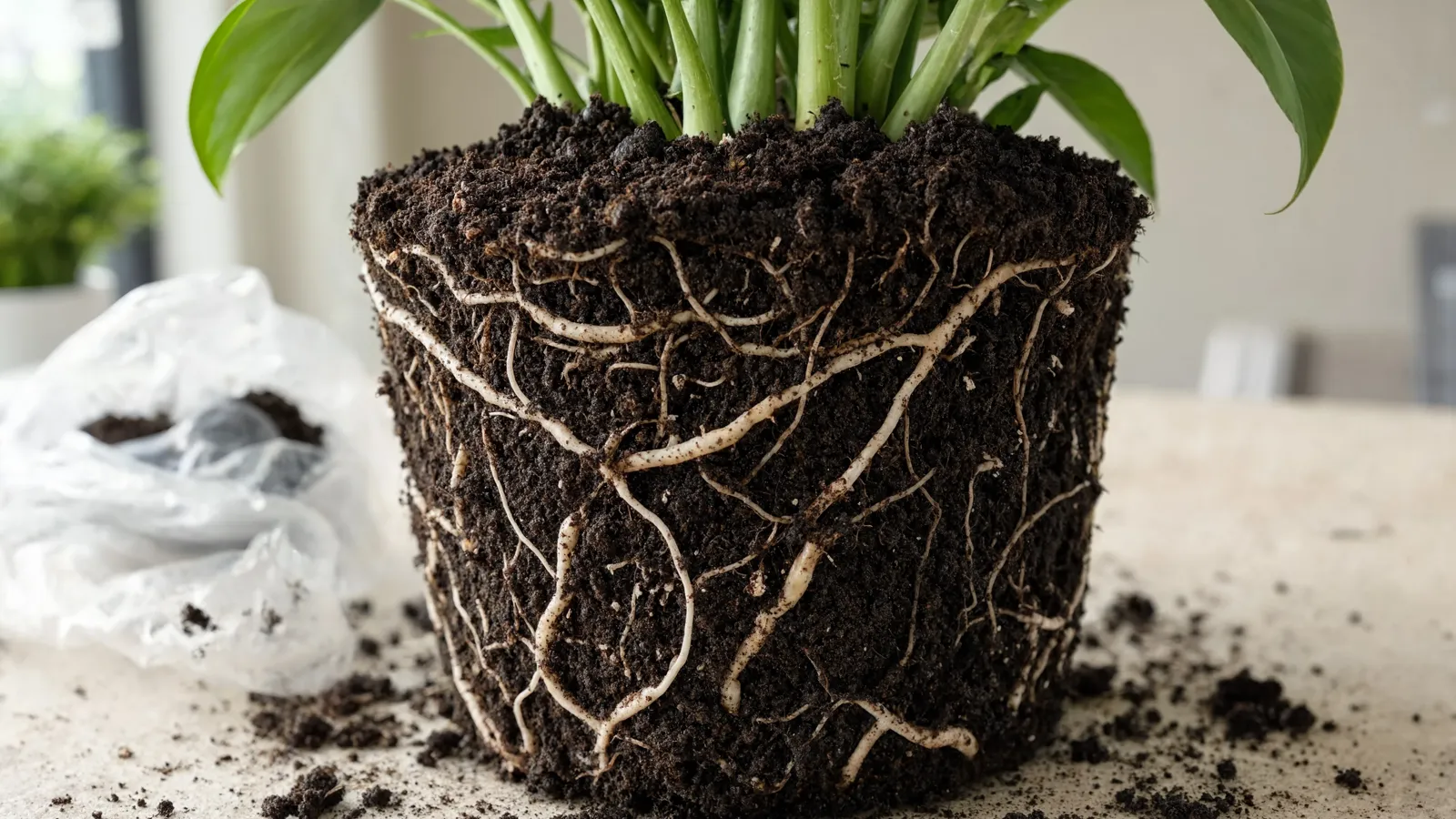
Diagnosing root rot requires unpotting: healthy roots are firm and white; Pythium-infected roots collapse to black, slimy strands that detach on contact.
Root Rot — Pythium & Phytophthora Infection
Commonly affects: Spathiphyllum wallisii (Peace Lily), Calathea orbifolia, Zamioculcas zamiifolia (ZZ Plant)
The plant wilts consistently even when the soil is moist or wet. Lower leaves yellow and drop rapidly, and stems near the soil surface may turn dark brown or black and feel hollow. On inspection, roots are black, slimy, and emit a distinctive fetid odour caused by anaerobic decomposition.
The short answer
Root rot is a consequence, not a cause — the roots suffocated in wet mix first, and Pythium moved into the dead tissue afterwards. That means fungicide alone rarely works. Take the plant out of its pot now, cut away every brown or mushy root, and repot into fresh, fast-draining mix in a pot no larger than the surviving root ball. If a third of the roots are still firm and pale, most plants recover.
Confirm it before you treat it
- 1Slide the plant out of the pot rather than digging in the surface. Rot starts at the bottom of the root ball, where water sits, and the top 5 cm can look perfectly healthy while the base has gone.
- 2Pinch a few roots. Healthy roots are firm and white to pale tan; rotted ones are brown or grey and the outer sheath slides off the thread inside when you pull gently.
- 3Smell the root ball. Healthy soil smells earthy. Rot smells sour, stagnant or faintly of drains.
- 4Estimate how much is left. Under a third firm and the plant is usually not recoverable from its roots — take cuttings instead while the top growth is still good.
- 5Check the stem base. If it is soft or discoloured where it enters the soil, the rot has left the roots and no amount of repotting will stop it.
Potential Causes
- 1Chronically saturated substrate creating anaerobic conditions that favour Pythium and Phytophthora oomycetes
- 2Contaminated potting mix or recycled soil carrying dormant pathogen spores
- 3Vessels with no drainage trapping moisture indefinitely around the root zone
- 4Cold, waterlogged conditions during winter dormancy slowing root respiration
Solution Steps
- 1Unpot the plant immediately and rinse all soil from roots under running lukewarm water.
- 2Using sterile pruning shears, remove all blackened or mushy root tissue, cutting back to firm white tissue.
- 3Soak remaining roots for 15 minutes in a dilute hydrogen peroxide solution (3% H₂O₂, 1 part to 4 parts water) to eliminate residual pathogens.
- 4Allow roots to air-dry in a warm, bright spot for 1–2 hours before repotting.
- 5Repot into a completely fresh, sterile mix in a clean pot — never reuse contaminated substrate.
- 6Water sparingly for the first two weeks to encourage new root growth without re-saturating.
What else looks like this
| Could be | How to tell it apart |
|---|---|
| Underwatering | Also wilts, but the mix is dry and the leaves are crisp at the edges. Root rot wilts while the soil is wet — that contradiction is the single most reliable tell. |
| Overwatering without rot | Yellow lower leaves and slow growth, but the roots are still firm and white. Caught here, drying out is enough; no repot needed. |
| Transplant shock | Wilting that begins within days of a repot and eases over one to two weeks, with the roots still firm. Rot worsens over the same period rather than easing. |
| Root-bound stress | Dense circling roots, water running straight through, and rapid drying — the opposite of the waterlogged mix rot needs. Roots are firm, just crowded. |
| Fungus gnat larvae damage | Fine roots chewed rather than decayed, with adult flies present. Damaged root tips look bitten off, not brown and slimy. |
Recovery timeline
- Day 1Repot into dry mix and do not water. Damaged roots cannot use water, and watering a freshly cut root system is what kills most rescued plants.
- Days 2–5Wilting may worsen slightly before it improves. The plant is drawing on stored reserves while cut roots callus over.
- Week 1First light watering, only around the edge of the pot. Leaves should stop drooping further.
- Weeks 2–4Existing leaves firm up. No new growth yet — the plant is rebuilding roots, which it does before it makes leaves.
- Weeks 6–10New growth appears. This is the point at which recovery is confirmed; anything before it is hope rather than evidence.
If you do nothing
Pythium and Phytophthora spread through wet substrate and consume root tissue faster than the plant can replace it. Once the rot reaches the crown the plant loses its ability to move water at all and collapses within days, often looking dramatically sudden after weeks of quiet decline. Both organisms also survive in the used mix and in unwashed pots, so a replacement plant put into the same pot frequently follows the first one.
Common mistakes
- Watering a wilting plant. Wilting-while-wet reads as thirst and is the exact opposite — every additional watering removes more oxygen from what is left of the roots.
- Repotting into a larger pot to 'give the roots room'. More mix holds more water for longer. The new pot should match the surviving root ball, not the old pot.
- Reusing the old mix or an unwashed pot. Both carry the pathogen. Wash pots with hot soapy water and start with fresh mix.
- Applying fungicide without removing dead tissue. Fungicide cannot restore decayed roots, and the dead tissue keeps feeding the infection.
- Cutting only the obviously black roots. Anything soft or discoloured should go — a partially rotted root does not recover and reinfects the rest.
Prevention Tip
Always sterilise second-hand pots with a 10% bleach solution and rinse thoroughly before reuse. Avoid terracotta glazed on the inside — unglazed terracotta allows lateral moisture exchange and greatly reduces root rot risk.
Questions people actually ask
- How much root can a plant lose and still survive?
- Roughly two thirds, for most houseplants, provided the crown is untouched. Below that, propagating healthy top growth has a far better success rate than trying to save the original root system.
- Should I cut back the leaves as well?
- Often yes. A reduced root system cannot support full foliage, and removing perhaps a third of the leaves lowers the water demand while the roots rebuild.
- Is hydrogen peroxide worth using?
- It oxygenates the mix briefly and kills exposed spores, which helps at the moment of repotting. It does not fix drainage, so on its own it delays the problem rather than solving it.
- Can I use the same pot?
- Yes, if you wash it thoroughly with hot soapy water and let it dry. Pythium survives on dry pot surfaces for months.
- Why did this happen when I water carefully?
- Watering frequency is only part of it. A dense mix, a pot without drainage, low light, or a cool room all extend how long the substrate stays wet, and any of them can cause rot at a watering routine that would be fine elsewhere.
Related Issues to Explore

Yellowing Leaves — Overwatering Stress
Soft, diffuse yellowing spreading from lower foliage — the plant's above-ground signal that roots are suffocating in waterlogged substrate.
Read guide
Stem & Crown Rot — Botrytis & Fusarium spp.
When root rot advances upward into the stem and crown, Botrytis and Fusarium cause rapid vascular collapse — often fatal within days.
Read guide
Interveinal Chlorosis — Iron or Magnesium Deficiency
Root damage from rot directly impairs micronutrient uptake, causing interveinal yellowing that mirrors deficiency even when nutrients are present in the soil.
Read guide