
Plant Clinic · Category
Leaf Problems
Yellowing, browning, drooping, curling, and other leaf issues across all houseplant species.
Leaves are the primary diagnostic tool for houseplant health. Changes in colour, texture, shape, and integrity reveal problems ranging from environmental stress and watering errors to pest damage and disease. This guide covers all leaf-related problems across our plant database — 32 conditions with causes, photos, and step-by-step fixes.
All Leaf Problems
 ⚠ Moderate
Monstera deliciosa
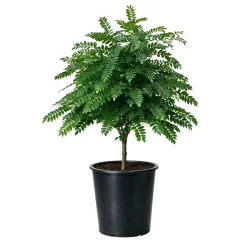
Yellowing Leaves — Overwatering Stress
Leaves turn uniformly pale yellow or lime-green, progressing from older lower foliage upward. Unlike nutrient deficiency, the yellowing is diffuse — no distinct green veining remains. Affected leaves feel limp and soft rather than crisp, and the potting substrate stays wet or waterlogged for extended periods.
 ⚠ Minor
Calathea orbifolia
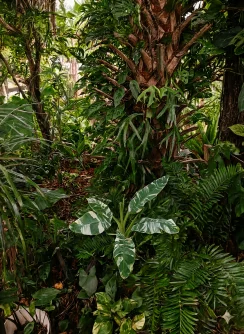
Brown, Crispy Leaf Tips — Low Humidity & Salt Stress
Leaf tips and outer margins turn brown, dry, and brittle. The browning begins at the very tip and progresses symmetrically inward along the leaf margins. Affected tissue is desiccated — sharply distinct from the healthy green centre. In severe cases, entire outer thirds of leaves are brown and paper-thin.
 ⚠ Moderate
Monstera deliciosa
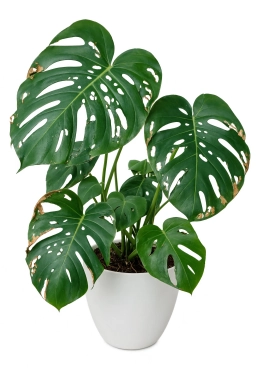
Chewing Damage — Caterpillars & Leaf-Eating Larvae
Irregular holes, ragged notches, and chewed margins appear in leaves, distinct from the natural fenestration of mature aroids. Dark pellets of frass collect on lower leaves or the soil surface, and a green or brown caterpillar may be found feeding on leaf undersides, often well camouflaged along a midrib. Damage typically appears overnight or progresses rapidly over a few days.
 ⚠ Moderate
Anthurium andraeanum
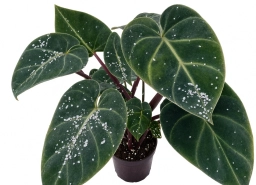
Tomato Spotted Wilt & Ringspot — Thrips-Vectored Virus
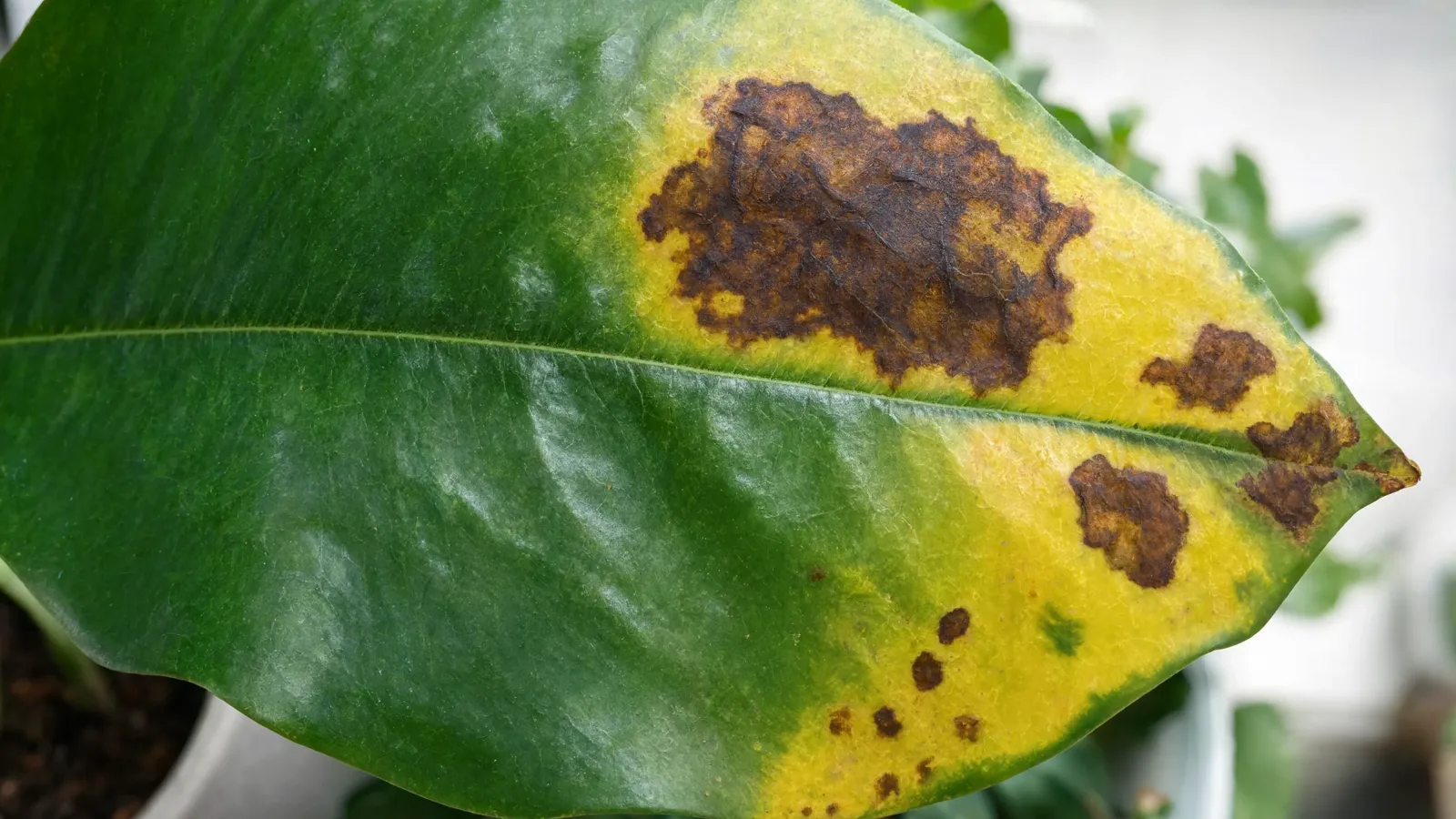
Leaves develop concentric chlorotic or necrotic ring patterns, line patterns, and irregular dead spots, sometimes with one-sided distortion or bronzing of the foliage. Affected plants are stunted and decline unevenly. The ring-and-line patterning is distinctive and persists across new growth, unlike fungal leaf spots which lack the concentric ring structure.
 ⚠ Moderate
Aglaonema
Cold Draught & Chilling Injury
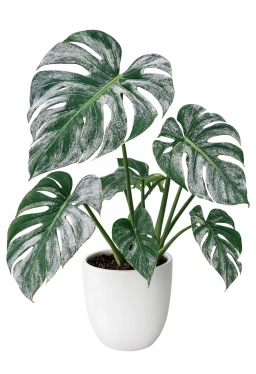
Leaves develop water-soaked or translucent patches that turn brown or black, often appearing suddenly after a cold night or exposure to a draught. Affected areas may be concentrated on the side facing a window or door, and whole leaves can yellow, blacken, and drop. Tropical aroids show damage at temperatures well above freezing — often below 10–12°C.
 ⚠ Moderate
Monstera deliciosa
Heat Stress & Leaf Curling
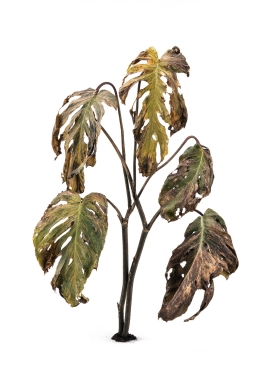
Leaves curl inward or downward, droop, and may develop dry, crisping margins during periods of excessive heat. The curling is a water-conservation response, reducing the exposed surface area as transpiration outpaces root uptake. Plants near heat sources or in hot, sunlit spots wilt despite moist soil and recover their posture as temperatures fall.
 ⚠ Minor
Monstera deliciosa
Guttation — Sap Droplets on Leaf Margins
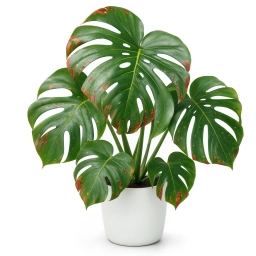
Clear, watery droplets form at the tips or margins of leaves, typically overnight or in the early morning, and may leave faint crusty mineral residue as they dry. This is a normal physiological process — root pressure forcing excess water out through specialised pores (hydathodes) — and is not a disease. It is most noticeable on Alocasia and Monstera when soil moisture is high and transpiration is low.
 ⚠ Minor
Philodendron spp.
Oedema — Corky Blisters from Water Imbalance
Small water-soaked bumps or blisters form on the undersides of leaves and along petioles, later hardening into raised, tan, corky, wart-like spots. The damage is caused by cells absorbing water faster than the leaf can transpire it, rupturing under the internal pressure. It is a physiological disorder, not contagious, and tends to appear during cool, damp, low-light spells.
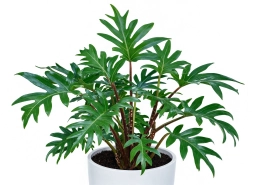 ⚠ Moderate
Aglaonema
Temperature Fluctuation Leaf Drop
Leaves yellow and drop, often without obvious pests or disease, in response to repeated swings between warm and cool conditions. The problem is common near draughty windows, in rooms with large day-night temperature differences, or where heating cycles on and off sharply. Older leaves are usually shed first as the plant repeatedly adjusts to the instability.
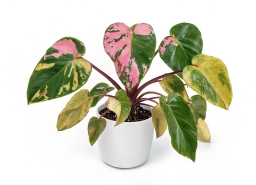 ⚠ Moderate
Alocasia spp.
Crinkled New Leaves & Stuck Leaf Syndrome
New leaves emerge crinkled, deformed, or fail to unfurl properly, sometimes tearing or remaining stuck inside the previous sheath. Thin-leaved and velvet-leaved aroids are most affected, and existing leaves may show crisping margins. The cause is typically chronically low humidity, which dries the delicate emerging leaf before it can expand fully.
⚠ ModerateMost aroids — Monstera
Fertiliser Burn — Nutrient Toxicity
Leaf tips and margins turn brown and crispy, often quite suddenly after feeding, and a white crust of fertiliser salts may appear on the substrate surface or pot rim. Roots can be chemically scorched, leading to wilting despite moist soil. The damage results from an excessive concentration of dissolved salts drawing water out of the roots — the opposite of the deficiency it is sometimes mistaken for.
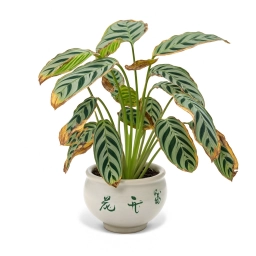 ⚠ Minor
Calathea
Chlorine & Fluoride Tip Toxicity
Leaf tips and margins turn brown and necrotic, often with a thin yellow band separating the dead tissue from healthy green. The damage accumulates gradually with each watering and is most pronounced on sensitive species that concentrate these elements at the leaf extremities. Unlike low-humidity tip burn, the cause is chemical — chlorine and fluoride in treated tap water.
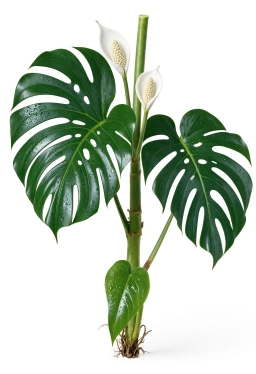 ⚠ Minor
Monstera deliciosa
Mechanical Leaf Tears & Handling Damage
Leaves show clean tears, splits, creased lines, bruised patches, or snapped tips that do not match any disease pattern. The damage is localised, often along a fold or at a point of contact, and does not spread or progress. Large, thin aroid leaves are particularly prone to tearing during handling, moving, or from contact with nearby objects and pets.
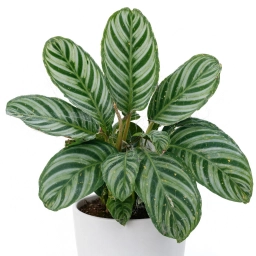 ⚠ Moderate
Calathea ornata
Calathea Leaf Curling — Underwatering, Low Humidity or Heat Stress
Calathea leaves curl inward along their length, forming tight cylinders or tubes rather than lying flat. The rolling is the plant's defensive mechanism to reduce the leaf surface area exposed to transpiration, conserving water when conditions are too dry, too warm, or when the root zone is failing to supply adequate moisture. Curled leaves may still appear green initially but will yellow and crisp if the cause is not addressed promptly.
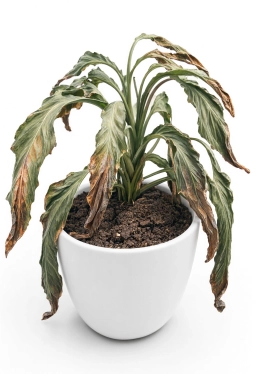 ⚠ Moderate
Spathiphyllum wallisii (Peace Lily)
Peace Lily Drooping — Underwatering, Root Damage or Heat Stress
Peace Lily leaves and stems lose rigidity and droop dramatically — petioles curve downward and leaf blades hang limply parallel to the pot. This is one of the most recognisable distress signals in houseplants. Peace Lilies droop both from underwatering (low turgor pressure in cells) and from advanced root rot (inability to transport water even when the soil is moist). Distinguishing between the two before watering is critical: watering a root-rotted plant accelerates its decline.
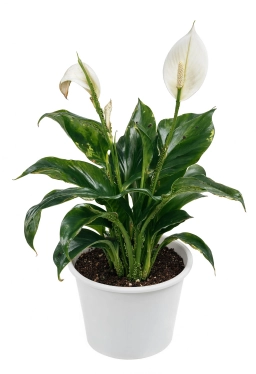 ⚠ Critical
Spathiphyllum wallisii (Peace Lily)
Peace Lily Leaves Turning Black — Cold Damage or Advanced Root Rot
Entire leaves or large sections turn black — not brown, but distinctly dark black or near-black — either rapidly following a cold event or progressively from the base of older leaves upward. Cold-induced blackening is usually sudden after temperature exposure and affects leaves uniformly. Root rot-induced blackening progresses more slowly and typically tracks from the base of the petiole upward as vascular tissue collapses.
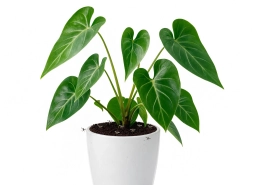 ⚠ Moderate
Philodendron erubescens
Black Leaf Tips — Cold Injury, Chemical Burn or Severe Dehydration
Leaf tips turn distinctly black — not the gradual tan-to-brown of low humidity tip burn, but rapid and sharply delineated blackening. The tissue collapses quickly and may develop a water-soaked or slimy appearance before drying. Black tips differ from brown tips in both cause and mechanism: browning is usually slow desiccation from humidity or salt stress, while blackening typically indicates rapid cellular collapse from cold, chemical exposure, or severe acute water stress.
 ⚠ Minor
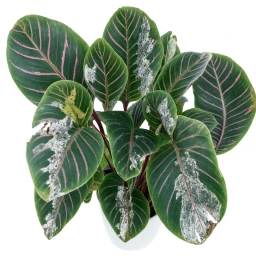
Calathea spp.
Chloramine Water Toxicity — Tip Burn Resistant to Standard Fixes
Persistent brown leaf tips and margins that do not resolve after switching to filtered water or leaving water to stand overnight. Unlike chlorine toxicity (which off-gasses within 24 hours), chloramine is a stable compound that cannot be removed by simple standing or aeration. Most modern municipal water treatment now uses chloramine rather than free chlorine — plants sensitive to halide compounds continue to show tip burn even when the grower believes they have addressed the 'chlorine problem'.
 ⚠ Moderate
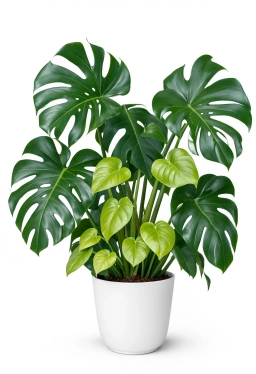
Monstera deliciosa
Leaf Shine Product Damage — Clogged Stomata & Waxy Residue Burns
Leaves develop a greasy, uneven sheen with brown or bronze patches, or show small necrotic spots at regular intervals corresponding to stomata openings. The plant's transpiration is visibly reduced — leaves may feel warmer than uncoated leaves at the same temperature. Over time, photosynthetic efficiency decreases and new growth may emerge smaller. Commercial leaf shine products (oils, waxes, silicone sprays) that are not formulated for plants block the microscopic stomata through which gas exchange occurs.
 ⚠ Minor
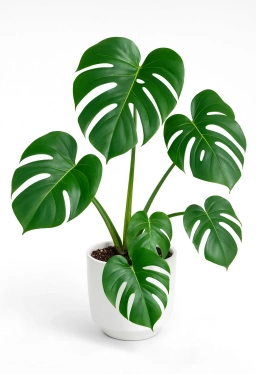
Monstera deliciosa
White Mineral Deposits on Leaves — Hard Water Calcium & Magnesium Residue
White, chalky, or powdery deposits appear on the upper surface of leaves, typically after misting, overhead watering, or in hard-water areas with high calcium and magnesium content. The deposits are not mould or a disease — they are mineral salts left behind when water droplets evaporate. While not directly harmful to leaf tissue, heavy mineral deposits reduce photosynthetic efficiency by blocking light penetration and can cause physical leaf damage when rubbed abrasively to remove them.
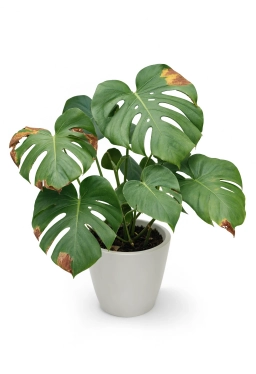
⚠ ModerateEpipremnum aureum (Golden Pothos
Pothos Yellow Leaves — Overwatering & Root Oxygen Deprivation
Lower leaves turn solid yellow and fall, or large sections of multiple leaves yellow simultaneously. The yellowing is typically uniform across the leaf rather than interveinal. The potting mix remains wet for extended periods. Pothos is extremely drought-tolerant — its roots absorb oxygen from air pockets in the substrate, and when those pockets fill with water for more than 5-7 days, roots begin to suffocate and die, triggering the characteristic yellow-then-drop cycle that is frequently mistaken for nutrient deficiency.
 ⚠ Minor
Epipremnum aureum — all cultivars especially Marble Queen
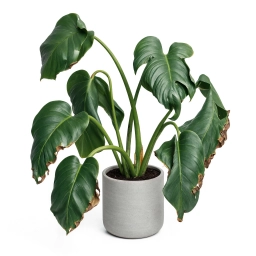
Pothos Brown Leaf Tips — Fluoride Toxicity, Salt Buildup & Low Humidity
The tips of otherwise healthy green leaves turn papery brown, with the brown zone progressively expanding inward along the leaf margins. The rest of the leaf remains green and turgid. This pattern — tip necrosis with a yellow halo between brown and green tissue — is the classic presentation of fluoride toxicity or accumulated fertiliser salt stress in Pothos. Tap water in many urban areas contains fluoride at 0.7-1.5 mg/L, which Epipremnum is particularly sensitive to.
 ⚠ Moderate
Epipremnum aureum — all cultivars
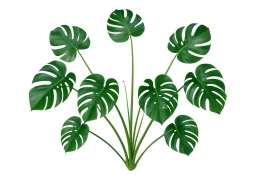
Pothos Brown Spots — Bacterial Leaf Spot & Cold Water Damage
Irregular brown spots appear on the leaf surface, sometimes with a yellow halo, sometimes water-soaked at the edges before turning brown. Spots may enlarge over days and merge. Bacterial leaf spot (Pseudomonas or Erwinia spp.) is a common cause in humid conditions with poor air circulation, while cold water applied directly to warm leaves causes cell damage that manifests as brown irregular marks. These two causes are sometimes confused — bacterial spots have a yellow halo and may spread; cold water damage is more random in placement and static.
 ⚠ Minor
Epipremnum aureum — all cultivars
Pothos Leaf Curling — Dehydration Stress, Cold & Root Restriction
Leaves curl inward along their length (edges rolling toward the midrib) or droop and curl downward. The plant looks thirsty but may not respond normally to watering. Leaf curling in Pothos is a water conservation response — by reducing the exposed leaf surface area, the plant slows water loss through transpiration. Unlike wilting (which is more extreme), curling indicates the plant is under stress and self-regulating before the situation becomes critical.
⚠ ModerateFicus lyrata (Fiddle Leaf Fig)
Fiddle Leaf Fig Sudden Leaf Drop — Environmental Shock & Relocation Stress
Multiple leaves drop simultaneously or in rapid succession within days of the plant being moved, repotted, or after a significant environmental change. Remaining leaves may be otherwise healthy. Ficus lyrata is extraordinarily sensitive to change — it is one of the most location-sensitive of all houseplants. Moving it even a few metres to a different light exposure, or a change in temperature, humidity, draught, or watering regime, can trigger a dramatic stress response of mass defoliation. This is not a sign the plant is dying — it is a measurable physiological response to perceived instability.
⚠ ModerateFicus lyrata (Fiddle Leaf Fig)
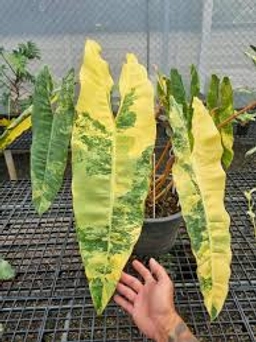
Fiddle Leaf Fig Brown Leaf Edges — Low Humidity & Inconsistent Watering
The edges of large leaves turn dry and crispy brown, progressing inward from the margin. The brown zone is sharply delineated from healthy green tissue. Unlike root-rot spots (which are irregular, blotchy, and spreading), edge browning follows the leaf margin consistently. This pattern indicates transpiration-related stress — the leaf margins are the furthest point from the central vascular supply and are the first to suffer when humidity is low, the soil fluctuates between very dry and very wet, or salts accumulate at the roots.
 ⚠ Critical
Ficus lyrata (Fiddle Leaf Fig)
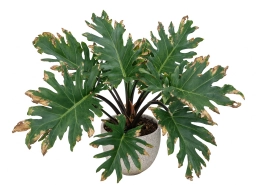
Fiddle Leaf Fig Bacterial Infection — Spreading Brown Spots with Yellow Halos
Small, water-soaked brown spots appear across the leaf surface, each surrounded by a distinct yellow halo. Unlike root-rot spots (which typically start at leaf margins or bases), bacterial spots appear anywhere on the leaf and spread rapidly in humid, warm conditions with poor air circulation. The spots merge to form larger irregular patches. Bacterial leaf spot in Ficus lyrata is caused primarily by Pseudomonas cichorii and enters through wounds or natural leaf openings, spreading via water droplets from watering or misting.
 ⚠ Minor
Ficus lyrata (Fiddle Leaf Fig)
Fiddle Leaf Fig Dry Brown Leaf Tips — Fluoride & Salt Accumulation
The tips of large Ficus lyrata leaves turn papery brown and dry, progressing inward along the leaf margins in a clean, defined line. The rest of the leaf remains healthy green and firm. This tip necrosis follows the classic pattern of fluoride toxicity or fertiliser salt accumulation — minerals concentrate at the leaf tips as water evaporates through the stomata, reaching toxic concentrations that kill the cells at these extremities.
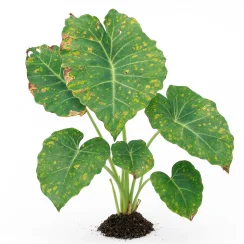 ⚠ Critical
Sansevieria trifasciata / Dracaena trifasciata (Snake Plant
Snake Plant Soft Mushy Leaves — Crown Rot from Overwatering
Leaves at the base of the plant become soft, watery, and translucent, eventually collapsing entirely. A foul, putrid smell may be present. When the leaves are pulled, they detach easily at the base. The soil is wet or has been kept consistently moist. Crown rot is the most devastating and most common serious problem in snake plants. The crown — the growing point at substrate level — is extremely susceptible to rot when moisture sits against it continuously. Once the crown rots, the entire above-ground plant dies and cannot be saved, though healthy leaves can be used as cuttings.
⚠ ModerateSansevieria trifasciata / Dracaena trifasciata — all cultivars
Snake Plant Yellow Leaves — Chronic Overwatering & Root Oxygen Starvation
Leaves turn uniformly yellow from base to tip, becoming soft and limp before eventually browning and collapsing. Multiple leaves may yellow simultaneously. The substrate is consistently moist. Yellow snake plant leaves almost invariably signal overwatering — either the frequency is too high, the drainage is inadequate, or the plant is sitting in too much shade reducing its minimal water consumption. Unlike most tropical plants that yellow from the older lower leaves first, snake plants typically yellow from the base upward as the root system fails.
⚠ MinorSansevieria trifasciata / Dracaena trifasciata — all cultivars
Snake Plant Brown Tips — Fluoride Sensitivity, Salt Buildup & Inconsistent Watering
The tips of upright leaves turn brown and papery, sometimes progressing down the leaf margins. The tip browning is dry, not soft or mushy — distinguishing it from rot. Snake plants are among the most sensitive houseplants to fluoride in tap water, and the long, upright leaf shape means minerals concentrate at the leaf tip as water evaporates from the stomata clustered near the apex. This is a cosmetic problem that does not threaten the plant's survival, but it progressively diminishes the clean appearance that makes snake plants attractive.
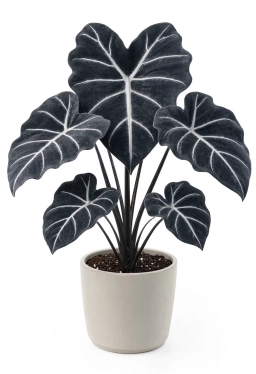 ⚠ Minor
Sansevieria trifasciata / Dracaena trifasciata — wide-leaf cultivars
Snake Plant Leaf Splitting — Physical Damage, Rapid Growth & Temperature Stress
Vertical splits appear along the length of otherwise healthy leaves, typically running parallel to the leaf veins. The splits may be clean and sharp, or ragged. Leaves remain firm and green except at the split edges. Splitting in snake plants is almost always from physical causes — rapid rehydration after drought (cells expand faster than the leaf can accommodate), mechanical damage from contact with objects, or extreme temperature differentials causing expansion stress. It is not a disease or pathogen.
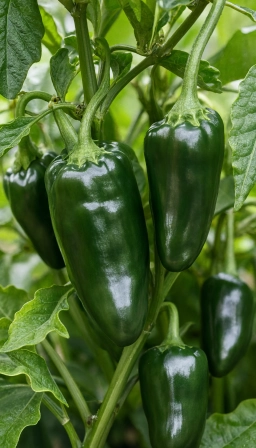 ⚠ Minor
Capsicum annuum
Leaf Curl on Chili Pepper Plants
Leaves curl upward or inward along their length, sometimes accompanied by a slightly leathery texture. New growth may emerge already curled. The plant otherwise continues growing, but the distorted foliage looks stressed.
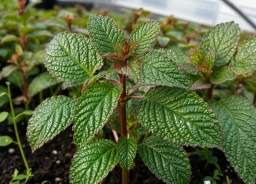 ⚠ Minor
Mentha spicata
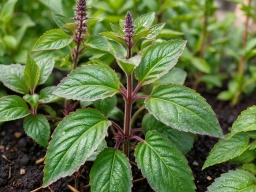
Yellowing Leaves on Mint
Leaves turn pale yellow, often starting with older, lower foliage while newer growth stays green. In containers, this is frequently accompanied by generally slower growth than expected.
 ⚠ Moderate
Ocimum basilicum (Basil)
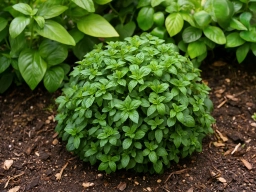
Basil Leaves Turning Black
Leaves develop dark, blackened patches or turn black entirely, often appearing suddenly after a cold night or exposure to a chilly draft. Affected tissue feels limp and doesn't recover once blackened.
 ⚠ Minor
Ocimum basilicum (Basil)
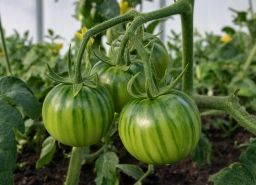
Yellowing Leaves on Basil
Leaves turn pale yellow, typically starting with older, lower foliage while new growth at the top stays green. Growth may also slow overall compared to expected vigour.
 ⚠ Minor
Solanum lycopersicum (Tomato)
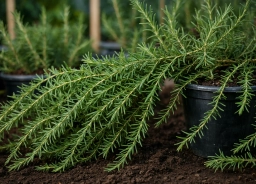
Leaf Curl on Tomato Plants
Leaves curl upward along their length, sometimes becoming slightly leathery. New growth may emerge already curled. The plant otherwise continues growing, though the distorted foliage looks stressed.
 ⚠ Moderate
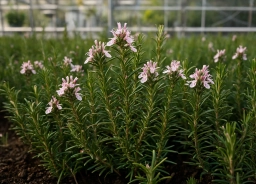
Salvia rosmarinus (Rosemary)
Rosemary Turning Brown and Dying Back
Sections of the plant, or the whole plant, turn brown and dry, with needles becoming brittle and falling off. New growth may stop appearing entirely on affected stems.
 ⚠ Minor
Salvia rosmarinus (Rosemary)
Yellowing Leaves on Rosemary
Needle-like leaves turn pale yellow, sometimes starting with older, lower growth. The plant may also look generally less vigorous than expected.
⚠ MinorPassiflora edulis (Passion Fruit)
Leaf Curl on Passion Fruit Vines
Leaves curl or cup, sometimes with a leathery texture, most often on new growth during heat stress or pest pressure.
⚠ CriticalMusa acuminata
Cold Damage and Chilling Injury in Banana
Leaves develop water-soaked blotches that turn brown-black after a cold night, and the whole plant can collapse if temperatures drop below freezing.
⚠ MinorMusa acuminata
Leaf Browning and Tip Burn on Banana
Leaf edges and tips turn brown and crispy, starting at the margins and progressing inward, most common on indoor or container-grown plants.
⚠ MinorMusa acuminata
Wind-Shredded Banana Leaves
Leaves develop long tears running from the edge toward the midrib, giving them a feathered or shredded appearance along their length.
⚠ MinorCucumis sativus (Cucumber)
Leaf Curl on Cucumber Plants
Leaves curl upward or inward, sometimes with a leathery texture, most often during heat stress or in response to pest feeding.
⚠ CriticalCarica papaya (Papaya)
Cold Damage and Chilling Injury in Papaya
Leaves develop water-soaked blotches that turn brown-black after cold exposure, and the tree can collapse entirely if temperatures drop near or below freezing.
⚠ MinorCarica papaya (Papaya)
Yellowing Leaves on Papaya
Older, lower leaves turn yellow and eventually drop, while newer growth at the top of the tree stays a healthier green.
⚠ ModerateFragaria × ananassa (Strawberry)
Winter Cold Damage to Strawberry Plants
Leaves and crowns show browning or blackening after severe winter cold, and unprotected plants can be killed outright in harsh winters without snow cover or mulch.
⚠ ModeratePhalaenopsis spp. and other Orchidaceae (Orchid)
Wrinkled or Pleated Leaves on Orchids
Leaves develop a wrinkled, accordion-like, or pleated texture rather than staying smooth and firm, sometimes accompanied by a dulled colour.
⚠ MinorPhalaenopsis spp. and other Orchidaceae (Orchid)
Yellowing Leaves on Orchids
A leaf turns yellow, sometimes starting from the base and progressing along its length, before eventually dropping.
⚠ ModeratePhalaenopsis spp. and other Orchidaceae (Orchid)
Cold Damage on Orchids
Leaves develop translucent, water-soaked patches that turn brown or black after cold exposure, often near a drafty window in winter.
⚠ MinorVarious succulents (Crassulaceae
Leaves Falling Off Succulents at a Touch
Leaves detach very easily from the stem with even gentle contact, sometimes without any other visible signs of stress.
⚠ MinorVarious succulents (Crassulaceae
Yellowing Leaves on Succulents
Leaves, often older ones, turn yellow before eventually dropping, sometimes accompanied by a soft or mushy texture.
⚠ ModerateVarious ferns (Polypodiopsida)
Crispy, Brown Fern Fronds
Frond tips and edges turn brown, dry, and crispy, sometimes spreading across the whole frond in advanced cases.
⚠ MinorVarious ferns (Polypodiopsida)
Yellowing Fern Fronds
Fronds turn yellow, sometimes uniformly and sometimes starting at the base, before eventually browning and dying.
⚠ ModerateVarious ferns (Polypodiopsida)
Leaflet or Frond Drop on Ferns
Individual leaflets or entire fronds drop from the plant, sometimes suddenly, reducing overall fullness.
⚠ MinorVarious palms (Arecaceae)
Brown Leaf Tips on Palms
The tips of palm fronds turn brown and dry while the rest of the leaf stays green, often the most common complaint with indoor palms.
⚠ MinorColocasia esculenta (Taro / Elephant Ear)
Yellowing Leaves on Colocasia
A leaf turns yellow, sometimes starting at the base of the leaf stem, before eventually collapsing and dying back.
⚠ MinorColocasia esculenta (Taro / Elephant Ear)
Leaf Splitting from Wind Damage on Colocasia
Large leaves develop tears or splits, particularly along the natural vein lines, especially in exposed or windy locations.
⚠ ModerateAloe vera (Aloe Vera)
Brown, Mushy Leaves on Aloe Vera
Lower or outer leaves turn brown, soft, and translucent, sometimes collapsing entirely, distinct from the normal grey-green colour of healthy leaves.
⚠ MinorAloe vera (Aloe Vera)
Brown Tips on Aloe Vera Leaves
The tips of leaves turn brown and dry while the rest of the leaf stays green and healthy.
⚠ MinorAloe vera (Aloe Vera)
Yellowing Leaves on Aloe Vera
Leaves, often the outer ones, turn yellow before eventually browning, sometimes accompanied by a soft texture.
⚠ ModerateZamioculcas zamiifolia (ZZ Plant)
Yellowing Leaves on ZZ Plant
Individual leaflets or entire stems turn yellow, often starting with lower leaves, before eventually dropping.
⚠ MinorZamioculcas zamiifolia (ZZ Plant)
Brown Spots on ZZ Plant Leaflets
Small, dry, brown spots appear scattered across leaflets, distinct from the widespread yellowing of overwatering.
⚠ ModerateZamioculcas zamiifolia (ZZ Plant)
Sudden Leaf Drop From Stress in ZZ Plant
Multiple leaflets or entire stems drop suddenly, often following a change in environment, watering, or location.
⚠ MinorZamioculcas zamiifolia (ZZ Plant)
Curling Leaflets on ZZ Plant
Leaflets curl or fold along their length rather than lying flat, sometimes combined with a duller colour.
⚠ MinorChlorophytum comosum (Spider Plant)
Brown Tips on Spider Plant Leaves
The tips of the arching leaves turn brown and dry while the rest of the leaf stays green — one of the most common Spider Plant complaints.
⚠ MinorChlorophytum comosum (Spider Plant)
Yellowing Leaves on Spider Plant
Leaves turn pale yellow or develop yellow streaking, sometimes progressing to overall decline if the underlying cause isn't addressed.
⚠ MinorChlorophytum comosum (Spider Plant)
Brown Edges Along Spider Plant Leaves
The edges (margins) of leaves turn brown and dry, distinct from the tip-only browning more commonly seen with water quality issues.
⚠ MinorChlorophytum comosum (Spider Plant)
Curling Leaves on Spider Plant
Leaves curl lengthwise or fold rather than lying in their normal arching shape.
⚠ MinorLavandula angustifolia / L. x intermedia (Lavender)
Yellowing Lower Leaves on Lavender
Leaves near the base of the plant turn yellow or grey and drop, while upper growth remains green and healthy.
⚠ MinorCapsicum annuum
Curled or Cupped Leaves on Bell Pepper
Leaves curl upward or cup, sometimes with a leathery texture, distinct from wilting.
⚠ ModerateCitrus limon (Lemon Tree)
Lemon Tree Dropping Leaves
The tree sheds a noticeable number of leaves, sometimes suddenly, even though remaining leaves may look otherwise healthy.
⚠ MinorCitrus limon (Lemon Tree)
Oedema (Water Blisters) on Lemon Tree Leaves
Small, corky, blister-like bumps develop on the undersides of leaves, sometimes turning brown or rust-coloured over time.
Plant-Specific Guides
.webp)
.webp)
Common Questions
What causes yellowing leaves — overwatering stress?
Leaves turn uniformly pale yellow or lime-green, progressing from older lower foliage upward. Unlike nutrient deficiency, the yellowing is diffuse — no distinct… Full guide →
What causes brown, crispy leaf tips — low humidity & salt stress?
Leaf tips and outer margins turn brown, dry, and brittle. The browning begins at the very tip and progresses symmetrically inward along the leaf margins. Affect… Full guide →
What causes chewing damage — caterpillars & leaf-eating larvae?
Irregular holes, ragged notches, and chewed margins appear in leaves, distinct from the natural fenestration of mature aroids. Dark pellets of frass collect on … Full guide →
What causes tomato spotted wilt & ringspot — thrips-vectored virus?
Leaves develop concentric chlorotic or necrotic ring patterns, line patterns, and irregular dead spots, sometimes with one-sided distortion or bronzing of the f… Full guide →