 ⚠ Minor
Pothos Brown Leaf Tips — Fluoride Toxicity, Salt Buildup & Low Humidity
Commonly affects: Epipremnum aureum — all cultivars especially Marble Queen
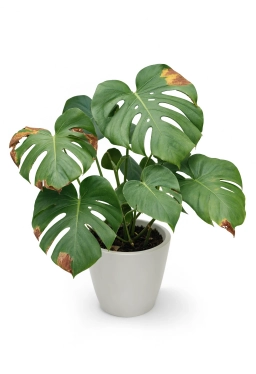
The tips of otherwise healthy green leaves turn papery brown, with the brown zone progressively expanding inward along the leaf margins. The rest of the leaf remains green and turgid. This pattern — tip necrosis with a yellow halo between brown and green tissue — is the classic presentation of fluoride toxicity or accumulated fertiliser salt stress in Pothos. Tap water in many urban areas contains fluoride at 0.7-1.5 mg/L, which Epipremnum is particularly sensitive to.
The short answer
Brown, crisp tips with a thin yellow band between the brown and the green usually mean something in the water — fluoride, chlorine or accumulated fertiliser salts — rather than dry air. Switch to filtered or rainwater, flush the pot thoroughly to wash out built-up salts, and stop feeding for a couple of months. Existing brown tips never recover; judge it on new leaves.
Confirm it before you treat it
- 1Look for the yellow band between the brown tip and the green leaf. That halo points to a toxicity or salt problem rather than simple dryness.
- 2Check the soil surface and pot rim for a white or yellowish crust. Salt build-up is visible and is the most common cause in a plant that gets fed regularly.
- 3Consider your water. Tap water with fluoride or chlorine causes this reliably in sensitive plants, and pothos is moderately sensitive.
- 4Review how you water. Small frequent watering that never drains concentrates salts, because nothing ever leaves the pot.
- 5Rule out dryness. If the mix regularly goes bone dry between waterings, inconsistent watering is the simpler explanation.
Potential Causes
- 1Fluoride in tap water accumulating in leaf tips over time as the plant transpires water and concentrates minerals at leaf margins
- 2Fertiliser salt buildup in the substrate from repeated application without periodic flushing, creating localised osmotic stress at the roots
- 3Relative humidity below 40% causing excessive transpiration that accelerates mineral concentration at leaf tips
- 4Physical damage to leaf tips from contact with cold walls, draughts, or accidental desiccation
Solution Steps
- 1Switch to filtered, rainwater, or distilled water for irrigation. Allow tap water to sit overnight to off-gas chlorine before use.
- 2Flush the substrate thoroughly every 4-6 weeks: water deeply until runoff is significant, wait 10 minutes, then water again. This leaches accumulated salts.
- 3Trim brown tips with sharp scissors at a slight angle to maintain a natural leaf shape. This is cosmetic only — it stops the spread if the cause is addressed.
- 4Increase local humidity to 50-60% using a humidifier or pebble tray with water below the pot base.
- 5If using fertiliser, reduce concentration to 25% of the recommended dose and apply at most monthly during the growing season.
What else looks like this
| Could be | How to tell it apart |
|---|---|
| Low humidity | Fine dry browning at the very tip with no yellow band, affecting thin-leaved plants nearby too. Pothos is fairly tolerant of dry air, so this is less often the cause than people assume. |
| Underwatering | Browning plus general drooping and light, bone-dry mix. The whole leaf feels limp, not just the tip. |
| Root rot | Brown tips alongside yellowing lower leaves and consistently wet soil. Check the roots before treating it as a water-quality issue. |
| Sunburn | Bleached pale patches on the leaves facing the window, not confined to the tips. |
| Normal leaf ageing | One old leaf at a time browning and dropping while the rest of the plant grows well. |
Recovery timeline
- Day 1Flush the pot: water slowly and heavily until several times the pot's volume has drained through, carrying dissolved salts with it.
- Week 1Switch to filtered, distilled or rainwater. Letting tap water stand overnight helps with chlorine but does nothing for fluoride.
- Weeks 1–8Stop feeding entirely. Existing tips stay brown — that tissue is dead and will not regreen.
- Weeks 4–8New leaves emerging with clean tips is the confirmation. Nothing else is.
- OngoingWater thoroughly until it drains every time rather than in small amounts, and flush the pot every few months.
If you do nothing
Salts keep accumulating with every watering and every feed, so the browning spreads from the tips along the margins and eventually across whole leaves. Rising salt concentration damages fine root hairs, which reduces water uptake and produces symptoms that look like drought on a plant in moist soil — at which point people water more and accelerate it. The plant rarely dies quickly, but it becomes progressively shabbier and each new leaf is affected sooner than the last.
Common mistakes
- Misting the plant. It does almost nothing for humidity and nothing at all for a salt or fluoride problem.
- Feeding a plant with brown tips. If salts are the cause, feeding is the opposite of the fix.
- Watering little and often. Without water draining out, salts only ever accumulate.
- Cutting off the brown tips and considering it solved. It is cosmetic; the next leaf browns the same way.
- Letting tap water stand overnight to fix fluoride. That works for chlorine, which evaporates, but fluoride does not.
Prevention Tip
Collect and use rainwater for Pothos — it is naturally low in fluoride, chlorine, and dissolved salts, and produces noticeably improved tip condition within 2-3 months.
Questions people actually ask
- Should I cut off the brown tips?
- Only for appearance. Trim just inside the brown, leaving a thin dead margin, and treat the actual cause separately.
- Is tap water really the problem?
- Often, yes, where the supply is fluoridated. The tell is the yellow band, which points at toxicity rather than dryness.
- How do I flush a pot properly?
- Water slowly in the sink until roughly three to five times the pot's volume has run through the drainage holes, then let it drain fully.
- Will a humidifier fix it?
- Only if low humidity really is the cause, and for pothos it usually is not. Check for the salt crust and the yellow band first.
- How long until new leaves look normal?
- Four to eight weeks, since it depends on the plant producing new growth. Faster in spring and summer than in winter.