




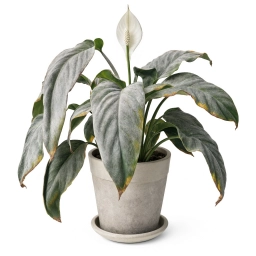
Peace Lily Care Guide
Spathiphyllum wallisii
Peace lily (Spathiphyllum) is one of the best houseplants for beginners. It tolerates low light, is highly expressive (wilts dramatically when thirsty but recovers quickly), and produces elegant white spathes with minimal care. It is also one of the few flowering plants that genuinely thrives in indoor conditions with no supplemental lighting.
One of the most forgiving houseplants — thrives in low light and signals when it needs water by wilting.
Care Requirements
💡 Light
Low to medium indirectOne of the most shade-tolerant houseplants. Thrives in north-facing rooms and offices with fluorescent lighting. Brighter indirect light encourages more flowering. Avoid direct sun — leaves scorch and bleach.
💧 Watering
Every 7–10 daysPeace lily will visibly wilt when it needs water — this is a reliable signal and does not harm the plant if it occurs occasionally. Water thoroughly and the plant will recover within hours. Keep consistently moist but not waterlogged. Use lukewarm water when possible.
💦 Humidity
40–60%Tolerates average household humidity well. Occasional misting or a pebble tray with water helps in dry heated rooms. Brown leaf tips indicate air is too dry.
🌡️ Temperature
16–27°CTolerates a wide temperature range but avoid cold below 10°C. Cold draughts cause leaf yellowing and wilting. Keep away from exterior doors and air conditioning vents.
🌱 Substrate
Rich, moisture-retainingPeace lily prefers a slightly richer substrate than most houseplants. Standard potting mix is suitable; add a small amount of compost for nutrients. Good drainage is still important — avoid dense, compacted soil.
⚗️ Fertiliser
Every 6 weeks (spring–summer)Peace lily is a light feeder. Feed with a balanced liquid fertiliser every 6 weeks during the growing season. Over-fertilisation causes brown leaf tips and mineral buildup on the substrate surface.
Seasonal Care
Peace lily flowers most abundantly in spring and occasionally again in autumn. Each spathe lasts 3–5 weeks before fading to green and then brown — cut spent flowers at the base. Year-round warmth promotes year-round flowering. A brief period of slightly brighter light in late winter encourages spring blooming.
Repotting
Repot every 1–2 years when roots emerge from drainage holes or the plant wilts within 1–2 days of watering. Peace lily prefers to be slightly pot-bound. Repot in spring for best recovery.
Propagation
Divide at repotting — separate the root ball into 2–3 sections, each with healthy roots and several leaves. Pot individually and keep moist in a warm location. Peace lily cannot be propagated from leaf or stem cuttings alone.
Peace Lily FAQs
Why is my Peace Lily drooping?
Drooping almost always means the plant needs water. Water thoroughly and it will recover within a few hours. If the substrate is already moist, drooping may indicate root rot — check the roots when you next repot.
Why is my Peace Lily not flowering?
Insufficient light is the most common cause. Move to a slightly brighter location — near a window receiving indirect light. Removing spent flower stems encourages new flower production. Commercial growers use gibberellic acid to force flowering; home growers can encourage it with brighter light and a balanced fertiliser.
Are Peace Lilies toxic to pets?
Yes — Peace Lily (Spathiphyllum) contains calcium oxalate crystals and is toxic to dogs and cats if ingested, causing mouth irritation, drooling, and difficulty swallowing. Keep out of reach of pets.
Something wrong with your Peace Lily?
Browse our full diagnosis guide — identification, treatment, and prevention for every common Peace Lily problem.
Peace Lily Problem Guide →Common Peace Lily Pests
Mealybug
White waxy-coated soft scale insects forming cottony colonies at leaf axils, stems, and roots.
View guide →
Spider Mite
Microscopic arachnids that cause bronze stippling and fine webbing, thriving in hot, dry indoor conditions.
View guide →
Scale Insect
Armoured or soft-shelled insects that attach to stems and leaves, extracting sap under protective waxy covers.
View guide →
Aphid
Soft-bodied sap-sucking insects that colonise new growth rapidly, excreting honeydew that leads to sooty mould.
View guide →
Compare Peace Lily
More Care Guides
.webp)
.webp)
🌿
Have a Peace Lily? Track its progress.
Weekly diary entries, photos, measurements — and a community of growers to learn from.