




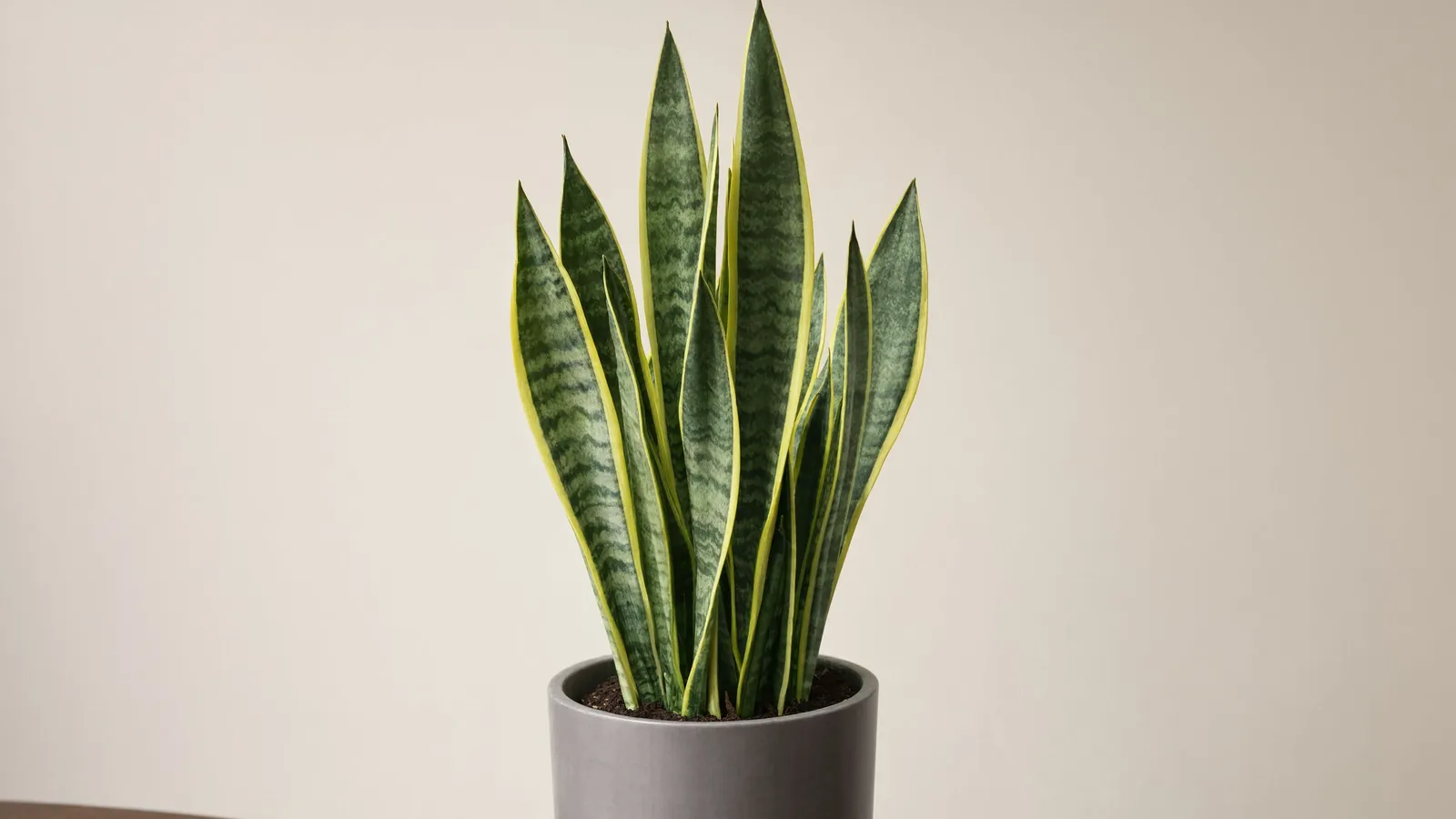
Snake Plant Care Guide
Sansevieria trifasciata
Snake Plant (Sansevieria trifasciata, now reclassified as Dracaena trifasciata) is one of the toughest houseplants available. It tolerates deep shade, irregular watering, low humidity, and temperature fluctuations that would kill other plants. The most common way to kill a Snake Plant is by overwatering — it stores water in its thick leaves and can go 4–6 weeks without water in winter.
Virtually indestructible — thrives on neglect and tolerates deep shade and weeks without water.
Care Requirements
💡 Light
Any — low to bright indirectTolerates deep shade but grows fastest in bright indirect light. The only limitation is prolonged direct mid-day sun, which causes leaf scorch. Variegated varieties (Golden Hahnii, Moonshine) need more light to maintain their patterns.
💧 Watering
Every 14–28 daysAllow the substrate to dry completely before rewatering. In winter, water as little as once every 4–6 weeks. Overwatering is almost the only way to kill a Snake Plant — the roots rot rapidly in wet, cold conditions.
💦 Humidity
10–50%Tolerates the lowest humidity of almost any houseplant. Thrives in bathrooms, offices, and centrally heated rooms where other plants struggle. No special humidity requirements whatsoever.
🌡️ Temperature
13–35°CExtremely temperature tolerant. Avoid frost — below 5°C will damage or kill the plant. Handles heat, air conditioning, and draughts without complaint.
🌱 Substrate
Sandy, very well-drainingUse a cactus/succulent mix or add 40–50% coarse sand or perlite to standard potting mix. Excellent drainage is essential — Snake Plant is highly susceptible to root rot in dense, moisture-retaining substrates.
⚗️ Fertiliser
Every 6–8 weeks (spring–summer)Requires very little fertilisation. Feed with a balanced liquid fertiliser at half strength 2–3 times during the growing season. Do not fertilise in autumn or winter.
Seasonal Care
Snake Plant grows slowly in winter and should receive minimal water during this period. New leaves emerge from the centre of the rosette in spring and summer. Individual leaves are long-lived — the same leaves may be present for several years. Offset pups appear around the base and can be separated to propagate new plants.
Repotting
Repot every 3–5 years or when the plant is pushing itself out of the pot (the roots are very strong and can crack plastic pots). Prefers to be pot-bound. Use a well-draining cactus mix. Heavy, stable terracotta pots prevent tall plants from toppling.
Propagation
Divide offsets at repotting — each pup with roots can be potted individually. Leaf cuttings are also possible: cut a leaf into 5–7 cm sections and insert upright into moist sand. Note: variegated varieties (Golden Hahnii) revert to plain green when propagated by leaf cuttings — divide offsets instead.
Snake Plant FAQs
How often should I water my Snake Plant?
Water every 2–4 weeks in summer when the substrate has dried completely, and as infrequently as once every 4–6 weeks in winter. Snake Plant stores water in its leaves and is far more tolerant of underwatering than overwatering.
Why is my Snake Plant drooping or soft?
Soft, mushy leaves indicate root rot from overwatering. Remove from the pot, cut away all rotted roots (black or brown and mushy), allow to dry for 24 hours, and repot in fresh, dry substrate. Reduce watering frequency going forward.
Can Snake Plants grow in low light?
Yes — Snake Plant is one of the most shade-tolerant houseplants. It will survive in very low light conditions but growth will be extremely slow. Bright indirect light produces the fastest growth and the most vibrant leaf colouring.
Something wrong with your Snake Plant?
Browse our full diagnosis guide — identification, treatment, and prevention for every common Snake Plant problem.
Snake Plant Problem Guide →Common Snake Plant Pests
Mealybug
White waxy-coated soft scale insects forming cottony colonies at leaf axils, stems, and roots.
View guide →
Spider Mite
Microscopic arachnids that cause bronze stippling and fine webbing, thriving in hot, dry indoor conditions.
View guide →
Fungus Gnat
Small black flies whose larvae feed on roots in moist organic substrate, causing wilting and yellowing.
View guide →
Scale Insect
Armoured or soft-shelled insects that attach to stems and leaves, extracting sap under protective waxy covers.
View guide →
Compare Snake Plant
More Care Guides

.webp)
.webp)
🌿
Have a Snake Plant? Track its progress.
Weekly diary entries, photos, measurements — and a community of growers to learn from.