


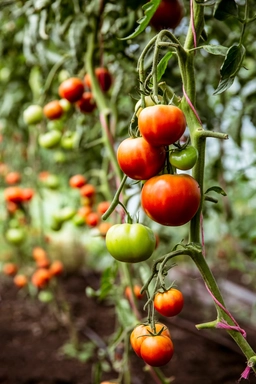
Tomato Care Guide
Solanum lycopersicum
Tomatoes are one of the most popular plants to grow at home, whether in a container on a balcony, a raised bed, or a grow tent indoors. They need plenty of light (6–8 hours minimum), consistent moisture, and regular feeding to produce a good harvest. Choosing the right variety for your space — compact determinate types for containers, indeterminate varieties for larger setups — is the first step to a successful grow.
Rewarding but requires consistent care — watering, feeding, and pruning make a big difference in yield.
Care Requirements
💡 Light
6–8+ hours direct sunTomatoes need full sun — at least 6 hours of direct sunlight daily, ideally 8+. Indoors, use a full-spectrum grow light (LED, 400–600 µmol/m²/s) for 16–18 hours per day. Insufficient light is the number one cause of poor fruit set and leggy growth.
💧 Watering
Consistently moist — daily in summerTomatoes need consistent moisture — irregular watering (dry then soaked) causes blossom end rot and fruit cracking. Water deeply every 1–2 days in hot weather; always check that the top 2–3 cm of soil is beginning to dry. Containers dry out faster than ground beds.
💦 Humidity
40–70%Moderate humidity is ideal. Very high humidity (above 80%) promotes fungal disease (blight, mould). Good airflow around plants reduces disease pressure significantly — space plants well and remove lower leaves.
🌡️ Temperature
18–29°C (day), 13–18°C (night)Tomatoes set fruit best between 18–29°C during the day. Temperatures above 32°C cause flowers to drop without setting. Cold nights below 10°C slow growth and can damage fruit. In cooler climates, start seeds indoors 6–8 weeks before last frost.
🌱 Substrate
Rich, well-draining potting mixUse a high-quality potting mix enriched with compost. Add perlite (10–15%) for drainage. Tomatoes are heavy feeders — start with a mix that contains slow-release fertiliser. Soil pH should be 6.0–6.8 for best nutrient availability.
⚗️ Fertiliser
Every 7–14 days once fruitingUse a balanced fertiliser (e.g. 5-5-5) during vegetative growth, switching to a high-potassium fertiliser (tomato feed, e.g. 4-4-8) once flowers appear. Consistent feeding every 1–2 weeks is essential for heavy yields. Avoid excess nitrogen after flowering — it promotes leaves over fruit.
Seasonal Care
In temperate climates, sow seeds indoors in late winter/early spring (February–March) and transplant outside after last frost. Harvest from midsummer to first frost — typically July to October. In warm climates (zones 9–11), tomatoes can be grown year-round. Indoors under lights, tomatoes can be grown in any season.
Repotting
Start seedlings in 10 cm pots, transplant to 20–30 cm pots at 6 weeks, and move to final containers (30–45 litres for indeterminate varieties, 15–20 litres for compact types) before they become root-bound. Burying the stem deeply when transplanting encourages extra root development along the buried stem.
Propagation
Grow from seed (sow 6–8 mm deep, germinate at 21–26°C, sprout in 5–10 days). Tomatoes can also be propagated from suckers — side shoots that emerge in the leaf axils. Root a sucker in water for 1–2 weeks and transplant. This is a free way to create new plants from an existing healthy specimen.
Tomato FAQs
Why are my tomato flowers dropping without setting fruit?
Flower drop is most commonly caused by temperatures that are too high (above 32°C) or too low (below 10°C at night), insufficient pollination, or inconsistent watering. Indoors, gently shake the plant daily or use a small brush to transfer pollen between flowers. Outdoors, bees handle this naturally.
How much water do tomatoes need per day?
Container tomatoes typically need 1–2 litres of water per day in summer, or enough to keep the soil consistently moist but never waterlogged. Large plants in full sun may need watering twice daily. Check the substrate daily — consistency is more important than quantity.
What is blossom end rot and how do I fix it?
Blossom end rot is a dark, sunken patch on the bottom of tomato fruit caused by calcium deficiency, usually the result of inconsistent watering rather than lack of calcium in the soil. Fix it by watering consistently, mulching to retain moisture, and ensuring the soil pH is between 6.0 and 6.8.
Should I remove tomato suckers?
For indeterminate (vining) varieties grown in containers or vertically, removing suckers improves air circulation and directs energy to fruit production. For determinate (bush) varieties, sucker removal is optional. Removing all suckers from a large garden plant reduces yield — prune selectively.
Something wrong with your Tomato?
Browse our full diagnosis guide — identification, treatment, and prevention for every common Tomato problem.
Tomato Problem Guide →Common Tomato Pests
Aphid
Soft-bodied sap-sucking insects that colonise new growth rapidly, excreting honeydew that leads to sooty mould.
View guide →
Spider Mite
Microscopic arachnids that cause bronze stippling and fine webbing, thriving in hot, dry indoor conditions.
View guide →
Whitefly
Tiny white-winged flies that cluster on leaf undersides, producing honeydew and transmitting plant viruses.
View guide →
Fungus Gnat
Small black flies whose larvae feed on roots in moist organic substrate, causing wilting and yellowing.
View guide →
Compare Tomato
More Care Guides
.webp)
.webp)
🌱
Growing Tomato? Track every week.
Log weekly updates, photos, and harvest notes — and see how your grow compares to others.